
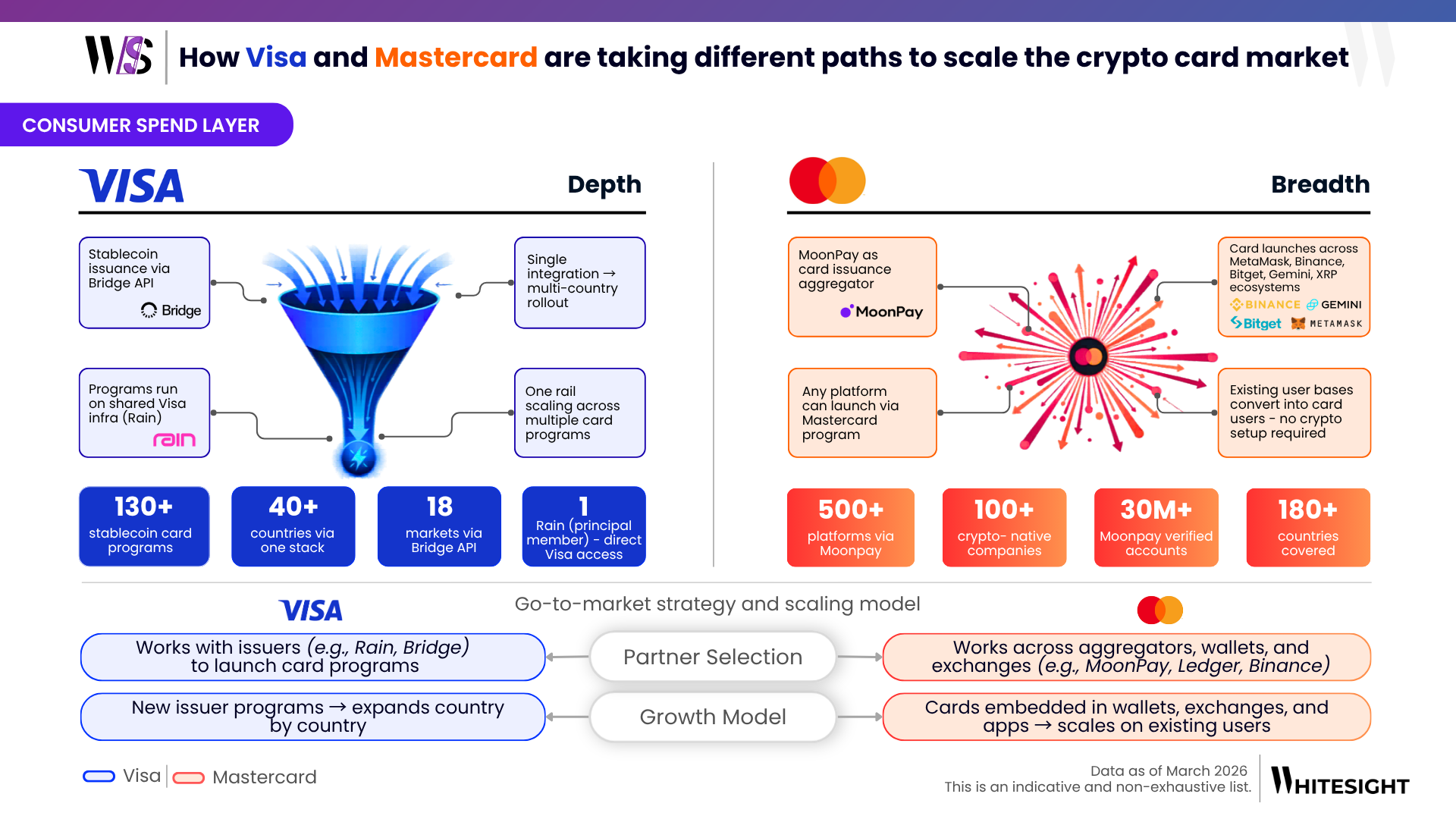

Visa and Mastercard are both expanding the crypto card market, with two different scaling models. Visa is building depth through issuer-led infrastructure, shared rails and multi-country program rollouts, while Mastercard is building breadth by embedding crypto cards across wallets, exchanges, aggregators and apps that already have large user bases.
Visa is building a deeper infrastructure-led model:
Visa’s approach is centred on stablecoin issuance through the Bridge API, shared Visa infrastructure through Rain, and issuer partnerships that can support multi-country card programs. With 130+ stablecoin card programs, 40+ countries via one stack, and 18 markets through the Bridge API, Visa is focused on creating repeatable infrastructure that can be reused across multiple programs and jurisdictions.
Mastercard is using ecosystem breadth to accelerate adoption:
Mastercard’s model is built around distribution through partners such as MoonPay, MetaMask, Binance, Bitget, Gemini and XRP ecosystems. By working across aggregators, wallets and exchanges, Mastercard can convert existing crypto users into card users without requiring them to set up new crypto accounts. Its reach across 500+ platforms via MoonPay, 100+ crypto-native companies, 30M+ MoonPay verified accounts, and 180+ countries points to a faster, more networked route to market.
The strategic split is about control versus reach:
Visa’s model gives it more control over issuer programs, infrastructure consistency and country-by-country expansion. Mastercard’s model gives it broader access to crypto-native communities by placing cards inside platforms where users already hold, trade or spend digital assets. This means Visa is strengthening the rails beneath crypto cards, while Mastercard is expanding the number of places where crypto cards can be launched and used.
The crypto card market is developing through two complementary but distinct playbooks. Visa is creating a deeper issuing and infrastructure stack that can support stablecoin-linked cards across markets with greater consistency. Mastercard is pushing for wider distribution by embedding cards into wallets, exchanges and crypto ecosystems with existing user bases.
Actionable insights on fintech, delivered regularly. Join Radar for exclusive fintech content and member benefits.
Don’t miss out on the next big fintech wave! Follow us on LinkedIn and subscribe to our Future of Fintech Newsletter to be the first to know about the Next Big Fintech Strategies.
Error: Contact form not found.
Don’t miss out on the next big fintech wave! Follow us on LinkedIn for daily updates and in-depth analysis. Subscribe to our weekly newsletter for curated insights delivered straight to your inbox. Unlock exclusive access to our membership plans for deeper dives into market trends, competitor analysis, and investment opportunities.
Error: Contact form not found.

Login to access Fintech intelligence
Sign up to access Fintech intelligence