
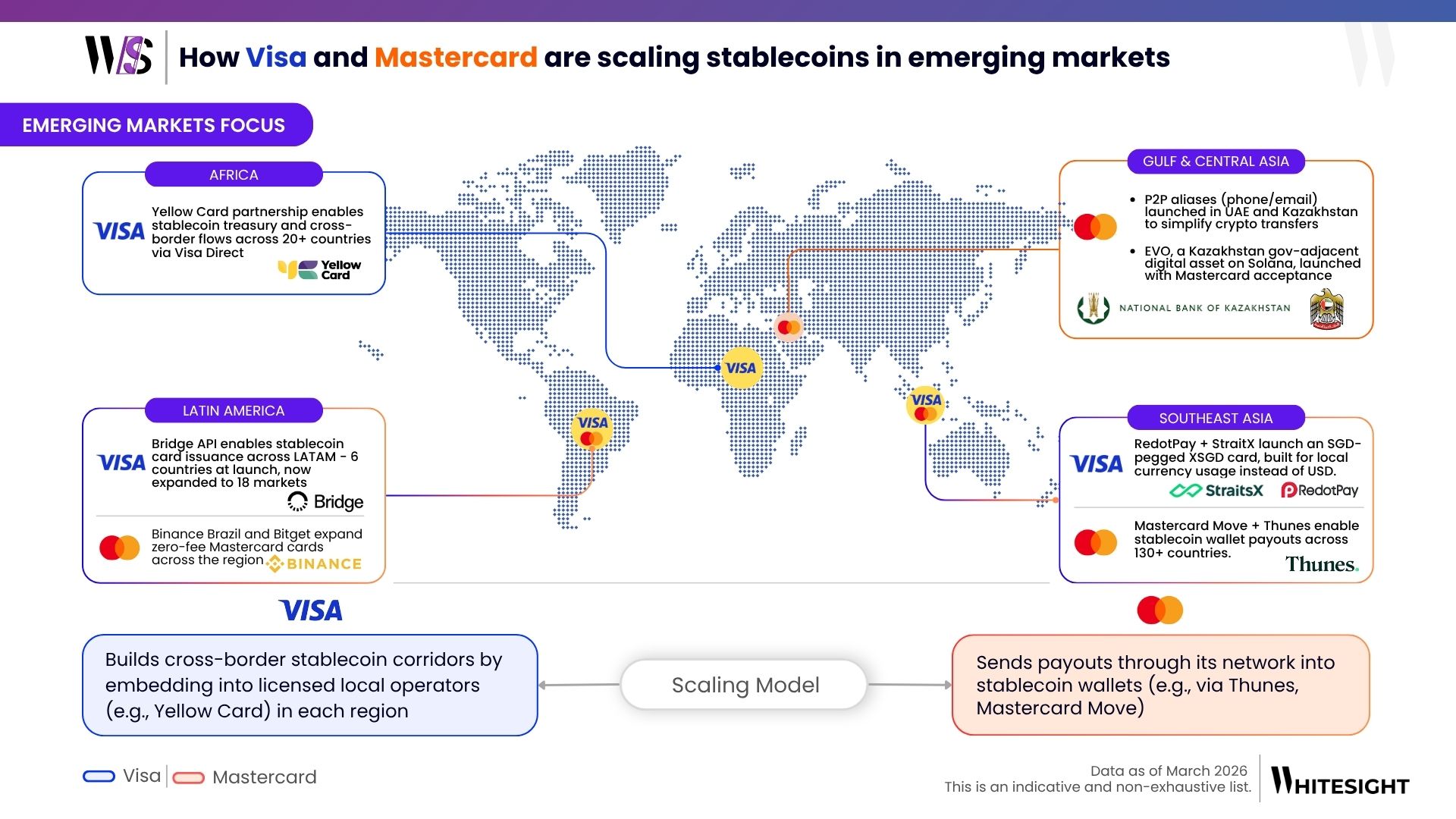

Visa and Mastercard are taking stablecoins into emerging markets by focusing on practical gaps: cross-border transfers, local currency access, card issuance, and faster payouts. The activity across Africa, Latin America, Southeast Asia, the Gulf and Central Asia shows that stablecoins are being positioned less as crypto products and more as infrastructure for money movement in markets where payment friction is still high.
1. Visa is building stablecoin corridors through licensed local operators:
Visa’s partnerships with Yellow Card in Africa and Bridge in Latin America show a corridor-led approach. By embedding stablecoin treasury, card issuance and cross-border flows into local operators, Visa can scale region by region while staying close to local compliance, liquidity and distribution needs. The model is especially relevant in markets where dollar access, FX friction and remittance costs create clear stablecoin use cases.
2. Mastercard is focusing on wallet payouts and ecosystem access:
Mastercard’s work with Thunes, Mastercard Move, Binance, Bitget, and public-sector pilots in Kazakhstan and the UAE points to a broader payout and acceptance strategy. Instead of only enabling card issuance, Mastercard is using its network to move funds into stablecoin wallets, support P2P crypto transfers and test government-adjacent digital asset use cases.
3. Local currency stablecoins are becoming a key differentiator:
The SGD-pegged XSGD card with RedotPay and StraitsX, Kazakhstan’s Solana-based digital asset pilot, and regional wallet payout models show that emerging market stablecoin growth will not be limited to USD rails. The next phase is likely to involve more local-currency stablecoins, regulated wallets and region-specific payout corridors.
Visa and Mastercard’s emerging market activity shows stablecoins moving toward real financial utility in regions where cross-border payments, FX access and payout infrastructure remain fragmented. Visa is leaning into local operators to build repeatable stablecoin corridors, while Mastercard is using wallet connectivity, payout rails and public-sector partnerships to widen access. Together, their moves suggest that emerging markets may become one of the most important testing grounds for stablecoins as everyday payment and settlement infrastructure.
Actionable insights on fintech, delivered regularly. Join Radar for exclusive fintech content and member benefits.
Don’t miss out on the next big fintech wave! Follow us on LinkedIn and subscribe to our Future of Fintech Newsletter to be the first to know about the Next Big Fintech Strategies.
Error: Contact form not found.
Don’t miss out on the next big fintech wave! Follow us on LinkedIn for daily updates and in-depth analysis. Subscribe to our weekly newsletter for curated insights delivered straight to your inbox. Unlock exclusive access to our membership plans for deeper dives into market trends, competitor analysis, and investment opportunities.
Error: Contact form not found.

Login to access Fintech intelligence
Sign up to access Fintech intelligence