
WhiteSight

Visa and Mastercard: Building the Settlement Layer for Onchain Finance

Two card network giants, one programmable settlement goal, and very different paths to get there

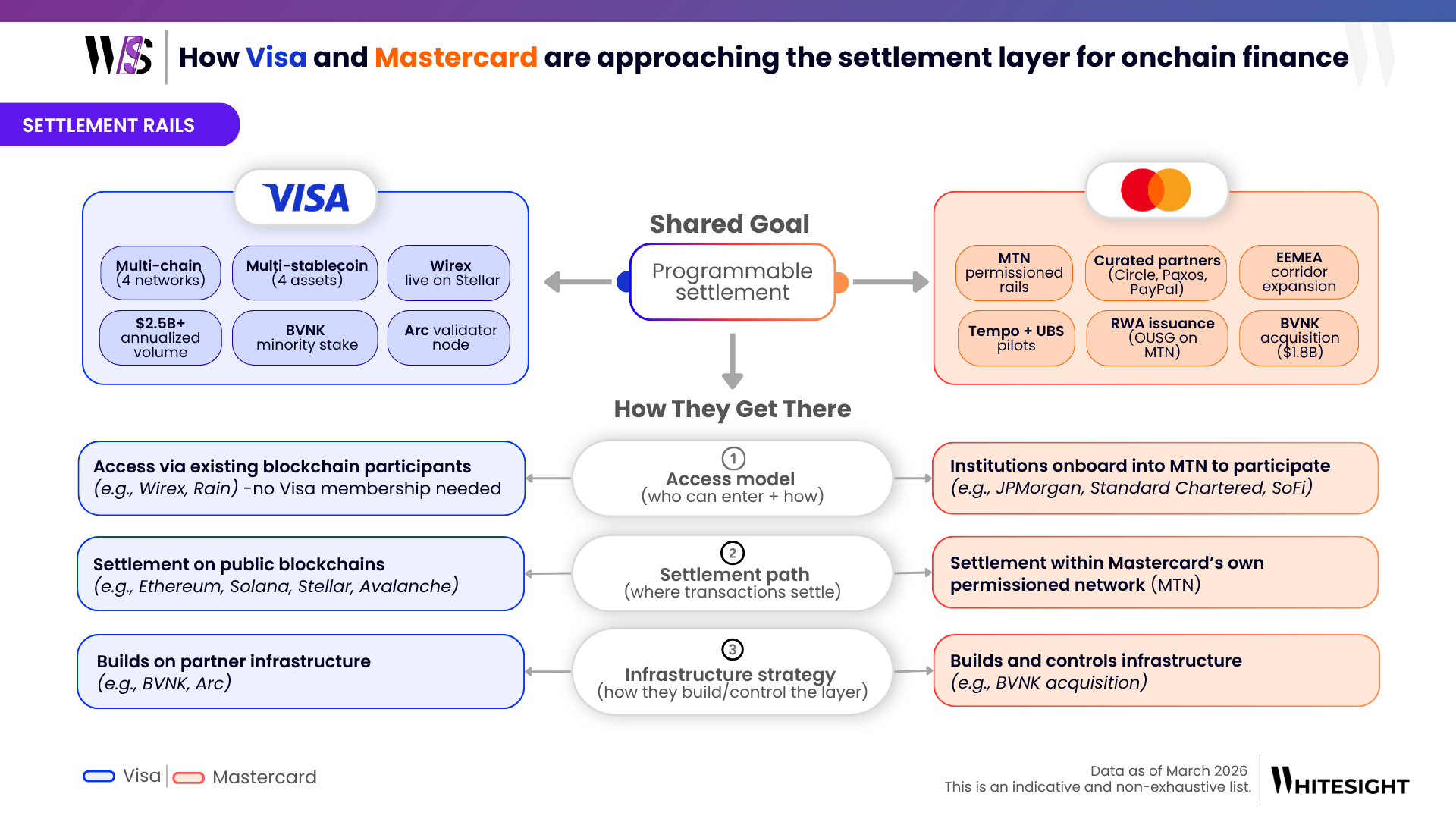
Visa and Mastercard are moving toward the same destination in onchain finance, programmable settlement. But their routes reveal two very different strategic philosophies. Visa is taking an open-rails, partner-led approach that extends its network into public blockchains, while Mastercard is leaning into a more controlled, permissioned settlement layer through MTN, curated partners, and owned infrastructure.

An infographic comparing Visa and Mastercard’s approaches to the settlement layer for onchain finance. It highlights their shared goal of programmable settlement while contrasting Visa’s focus on public blockchains (Ethereum, Solana) and partner infrastructure with Mastercard’s use of its Multi-Token Network (MTN) and controlled infrastructure.
Explore the full roundup on how Visa and Mastercard are building their onchain finance playbooks across crypto cards, settlement rails, stablecoins, and institutional networks.
Roundup
  • Visa is treating blockchain settlement as an extension layer, not a closed network:
    Visa’s strategy appears designed to meet onchain activity where it already exists — across public blockchains, stablecoins, and crypto-native infrastructure partners. Its multi-chain and multi-stablecoin setup, Wirex on Stellar, BVNK minority stake, and Arc validator node all point to a model where Visa enables settlement through existing blockchain participants without requiring traditional Visa membership at every entry point.
  • Mastercard is building a more institution-friendly settlement environment: Mastercard’s MTN approach reflects a permissioned model built for banks, fintechs, and regulated institutions that need control, compliance, and defined participation. Its pilots with Tempo and UBS, OUSG issuance on MTN, EEMEA corridor expansion, and partners such as Circle, Paxos, PayPal, JPMorgan, Standard Chartered, and SoFi show a strategy focused on structured institutional adoption rather than open-chain breadth.
  • The real battleground is infrastructure control: Visa is scaling through partners such as BVNK and Arc, while Mastercard’s BVNK acquisition signals a stronger push to own and control the settlement stack. The shared goal is programmable settlement, but the competitive divide is clear: Visa is optimizing for reach across public blockchain rails, while Mastercard is optimizing for trust, governance, and institutional-grade control.

Visa and Mastercard’s onchain strategies show that the next phase of payments competition is shifting below the customer-facing layer and into settlement infrastructure. Visa is positioning itself as an open connector across public blockchains, stablecoins, and crypto-native partners, giving it breadth and flexibility across emerging rails. Mastercard, meanwhile, is building a more controlled institutional environment through MTN, curated participation, and infrastructure ownership. 

Get Unlimited Access to Strategy Playbooks of Fintech Pioneers! 🚀

Fintech's future on your radar

Actionable insights on fintech, delivered regularly. Join Radar for exclusive fintech content and member benefits.

Be the First to Know About the Next Big Fintech Strategies!

Don’t miss out on the next big fintech wave! Follow us on LinkedIn and subscribe to our Future of Fintech Newsletter to be the first to know about the Next Big Fintech Strategies.


    Don’t miss out on the next big fintech wave! Follow us on LinkedIn for daily updates and in-depth analysis. Subscribe to our weekly newsletter for curated insights delivered straight to your inbox. Unlock exclusive access to our membership plans for deeper dives into market trends, competitor analysis, and investment opportunities.

    We publish new research regularly. Subscribe to stay updated.
    No spam. Only the best in class fintech analysis.


      Related Posts
      Select currency
      WS_Logo_-for-White-BG-01.png