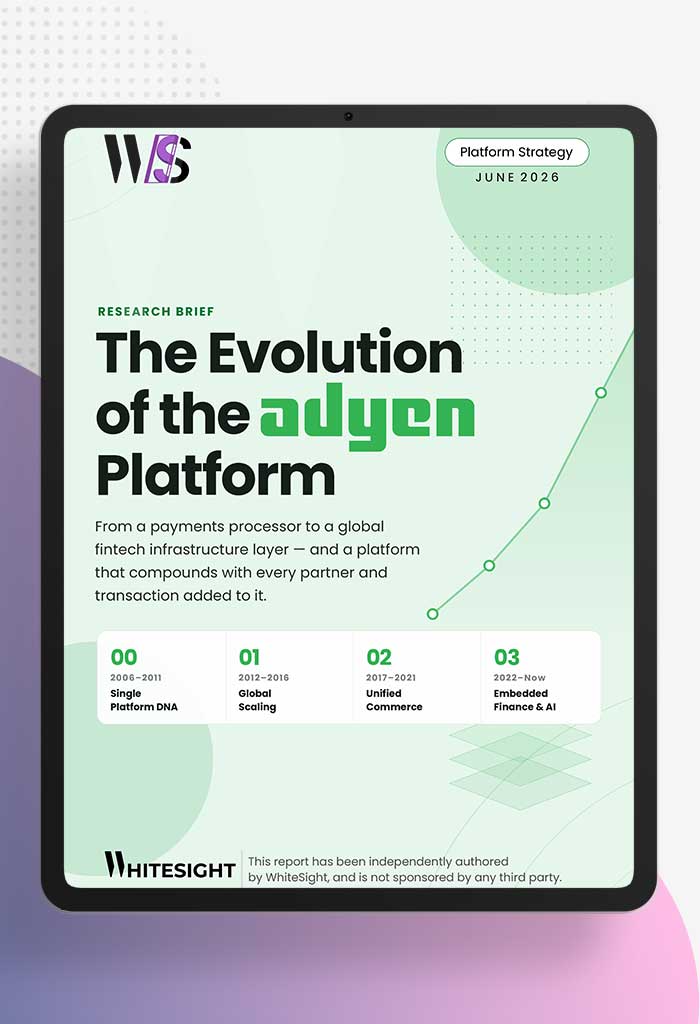
Adyen is one of those companies that still gets described as a payments processor, even though the business has moved far beyond that label. What began as a single-platform payments stack in 2006 has evolved into a global fintech infrastructure layer spanning acquiring, unified commerce, embedded finance, AI, and platform-led distribution.Adyen avoided the usual payments trap: growing by stitching together local providers, point solutions, and market-specific integrations. Its bet was architectural discipline. Build the stack in-house, keep one global integration, and let every new layer compound on the same core. A single-platform foundation in 2006. Global scaling from 2012. Unified Commerce from 2017. Embedded finance and AI from 2022 onward. Each phase expanded the surface area, but preserved the same underlying logic.
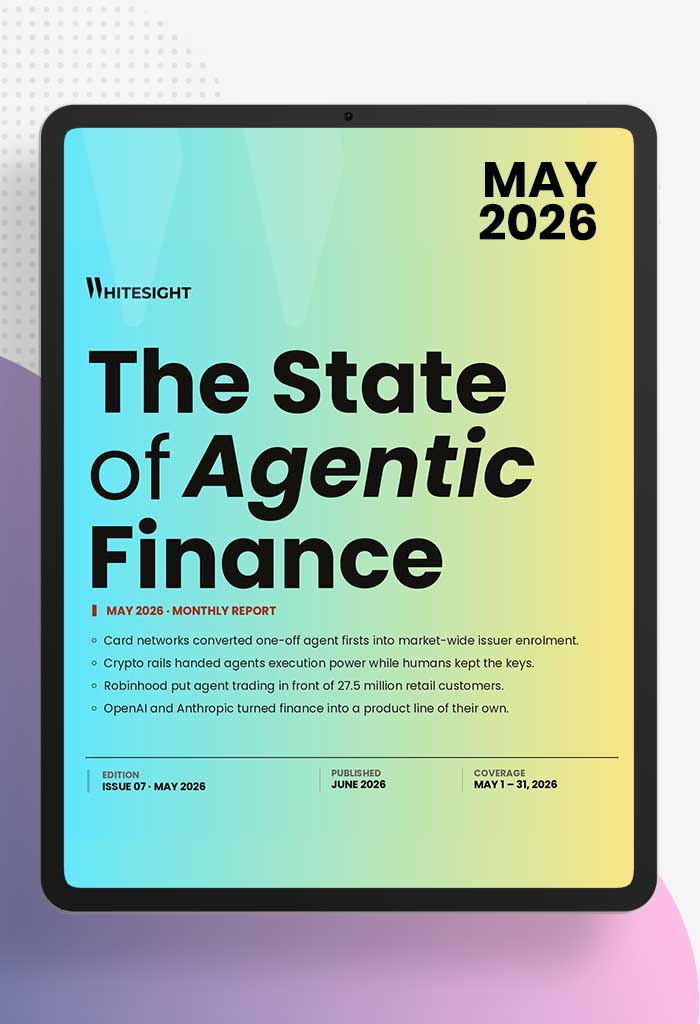
In May 2026, agentic finance moved from isolated proofs into distribution infrastructure. Mastercard took Agent Pay live across Portugal and the Netherlands. Visa expanded Agentic Ready across Asia Pacific and CEMEA, enrolling issuers before agent volume arrives. Stripe, Coinbase, Circle, Fireblocks, MoonPay, and AWS turned crypto and stablecoin rails into usable infrastructure for agent-initiated payments. Banks stopped treating agents as experiments. Fiserv and FIS packaged agent capabilities for bank clients. Lloyds and Citi built internal agent platforms with marketplaces, monitoring, and audit. Robinhood opened brokerage and card rails to customer-controlled AI agents. OpenAI connected ChatGPT to more than 12K+ financial institutions, while Anthropic turned finance agents into off-the-shelf products.
Singapore is often painted as the crown jewel of Asian fintech, highly digital, affluent, and open to innovation. But it is also crowded and highly competitive. While well-funded local consortia built full-scale digital banks and absorbed heavy losses, Revolut took a leaner path. Operating without a full banking licence, the UK challenger grew its Singapore retail customer base by 40% and reached a 15% net profit margin in 2024. That raises a compelling strategic question: how did Revolut capture the highly lucrative Singapore market while capital-heavy digital banks stalled in the red?
From simplifying online payments for developers to processing $1.9T in annual payment volume, Stripe has evolved into one of the most important financial infrastructure companies powering the internet economy. Stripe’s next act is expanding the scope of payments infrastructure, powering AI-native businesses, agent-led commerce, and programmable money movement across the next generation of digital transactions. At WhiteSight, we’ve unpacked the strategy behind Stripe’s expansion, decoding how its product stack, AI investments, platform ecosystem, and stablecoin bets are reshaping the future of payments, commerce, and financial infrastructure.
In a market where many fintechs are still fighting to prove single-product economics, SoFi has taken a different route: turning a student-loan refinancing wedge into a full-stack financial platform with banking, lending, investing, and B2B infrastructure under one roof.
What began as a niche play for high-earning graduates has evolved into a nationally chartered bank, a multi-product consumer finance ecosystem, and an infrastructure business powered by Galileo and Technisys. With 13.7M members, 20M+ products, and a growing fee-based revenue engine, SoFi is trying to become the operating system behind modern financial services.
Behind the rapid growth and shifting dynamics of the modern digital payments landscape, Affirm’s evolution from a POS financing provider into a broader consumer payments platform offers a useful lens into how the BNPL model is changing. For years, the financial ecosystem watched to see if a BNPL model could withstand changing economic conditions, move past the single checkout button, and reach consistent profitability. Affirm has navigated all three challenges. Today, with its consumer network expanding across North America and into the UK, the focus has shifted toward understanding how it evolved its transactional credit engine into a broader financial ecosystem.Affirm achieved this by looking beyond the traditional, short-term interest-free framework that initially defined early fintech lenders. Instead, it shaped a balanced model where interest-bearing options serve larger purchases, complemented by targeted, merchant-subsidized promotions that help retailers drive their own sales. By 2025, this flexible design yielded unmistakable scale, with net revenue climbing to $3.2B and the company reporting a positive net income of $52M.
Colombia’s central bank caps interest rates at approximately 25%. Any borrower whose risk profile requires higher pricing gets rejected. The regulation was designed to protect consumers from predatory lending. In practice, it locks 65% of the adult population out of formal credit and pushes 11 million Colombians into gota-a-gota, informal street lending at 382% APR for individuals and 667% for small businesses.Nu Colombia entered this market in September 2020 with a single credit card. By early 2026, it had reached 4.2 million customers, the #1 net credit card issuer position every year since 2022, and 8% credit card market share, all within the usury ceiling.
From its origins as a Swedish checkout innovator to its reinvention as an AI-native commerce and financial platform, Klarna’s story has moved far beyond BNPL. What began as a way to reduce friction between shoppers and merchants has become a two-sided ecosystem spanning payments, credit, savings, cards, shopping discovery, and merchant growth tools, serving 118M active consumers and 1M+ merchants across 26 countries.
Klarna is now attempting one of the most ambitious pivots in fintech: transforming a credit-led BNPL model into a full-stack commerce and financial platform. Its engine is the loop between 3.4M daily transactions, real-time underwriting, AI-powered discovery, and merchant monetization, a model designed to convert episodic purchases into everyday financial engagement.
The UK has produced four structurally distinct digital banking models — and all four are now profitable in the same market cycle. We’ve deconstructed each strategy into its own deep dive. Here, all four, together. (Monzo + Revolut + Starling + Allica Bank)Each model made a different bet on which customer, which product, and which revenue engine would compound fastest. At WhiteSight, we’ve deconstructed all four strategies across four standalone deep dives, now available as a single bundle at 42% off the individual price.
In a market often called the neobank graveyard, where even local challengers have struggled to survive, Revolut has managed to carve out a different path in Australia. By starting with a sharp transactional wedge: solving the headache of cross-border payments, they have steadily moved into the daily heartbeat of small businesses. With the launch of merchant acquiring, Revolut is shifting from a useful tool to a durable platform, using live data to rewrite the rules of SME banking.
In April 2026, Mastercard completed its first live authenticated agentic transaction in Hong Kong. Coinbase launched a marketplace where AI agents discover and transact using stablecoins. Anthropic unveiled Mythos, a cybersecurity AI model so advanced it refused to release it publicly. US Treasury Secretary Bessent and Fed Chair Powell held emergency talks with bank CEOs about the financial stability risks it created.Card networks shipped proprietary agent protocols in parallel. Crypto rails emerged as default settlement infrastructure for autonomous AI transactions. Banks moved AI agents from backend pilots into boardrooms, mortgage advice, and wealth management. Over $150 billion in AI infrastructure capital was committed in a single month.
For years, foreign neobanks tried to crack the US market by borrowing someone else’s banking rails. Then the rails began to break.Sponsor-bank models came under pressure, middleware-led BaaS structures broke down, co-brand partnerships revealed difficult unit economics, and regulators pushed the ecosystem toward greater accountability. What first appeared to be a narrowing market may have created the opening Nubank needed. Unlike earlier foreign digital banks that relied on sponsor-bank arrangements, Nubank entered the US with conditional approval for a full national bank charter, a compliance-first operating history, and a product strategy informed by the lessons of the Synapse collapse and major co-brand card failures.