WhiteSight

How Nubank Plans to Enter the US Without the Cold Start Problem

Table of Contents

Try renting an apartment in Miami without a US credit score. Try financing a used car in Houston. Try getting a phone plan in Los Angeles without a Social Security number tied to a bureau file. Millions of Latino immigrants face this sequence every year. They hold jobs, pay rent on time, and send money home to their families every month, yet the financial system records none of it. The credit bureau has no file on them. In the eyes of the traditional scoring model, they do not exist.

This is the reality for a population that contributes $4 trillion to the US economy annually.

One person who recently experienced this firsthand was Cristina Junqueira, the co-founder of the world’s largest digital bank, who relocated to Miami last year. She carried a billion-dollar stake in Nubank and a decade of credit expertise across three countries. Her first personal financial task in the US was ordinary: apply for a credit card. The process took months, routed through a major bank’s private banking desk.

If the system struggles to read a billionaire with twelve years of banking experience, it has a measurement problem. Junqueira’s rejection reflected a structural pattern shared by millions of Americans that the traditional credit bureau cannot score.

She is now building the bank that would have approved her, in the city that turned her away.

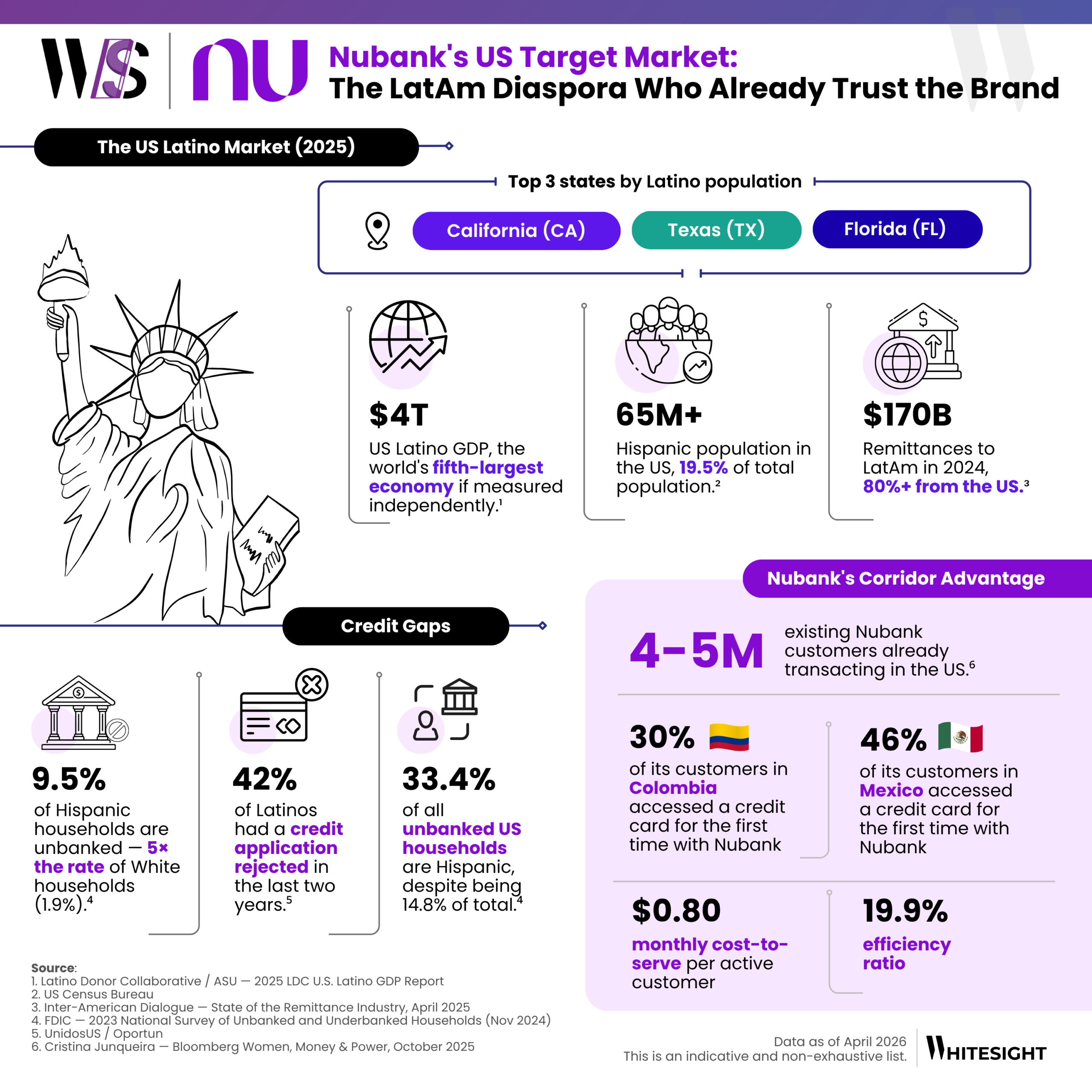
Infographic titled "Nubank's US Target Market" showing US Latino GDP of $4T, remittance data, and Nubank's low cost-to-serve metrics.

The Fifth-Largest Economy the Credit System Cannot Read

The US Latino population contributes $4 trillion to GDP annually, the world’s fifth-largest economy if measured independently. The credit infrastructure serving this population has a reading problem.

The Federal Reserve named the borrowers that this system misses. Its October 2025 report introduced the term ‘invisible primes.’ These are borrowers who appear subprime on bureau data while carrying low default risk. The traditional scoring model reads repayment history on past credit, and anyone without that history gets filtered out, regardless of actual financial behaviour.

92% of US Hispanics already use fintech products, the highest adoption rate of any demographic in the country. The demand for better financial products exists at a scale that the credit infrastructure has failed to serve.

Every foreign digital bank that tried the US market saw this opportunity. None could reach it.

From charter application to conditional approval, capitalisation deadlines, and supervised operations, Nu’s U.S. journey reflects a carefully staged institutional build. This report unpacks what this timeline reveals about Nu’s long-term banking strategy in the U.S. Check out the full report now!
Report

The Cold-Start Graveyard

The pattern is consistent. Foreign digital banks entered the US through sponsor bank partnerships and failed. N26 exited in January 2022 after reaching approximately 500,000 customers through Axos Bank. Monzo exited in March 2026 after operating through Sutton Bank, the same institution that received an FDIC consent order for BSA violations in February 2024. Neither could hold deposits directly, offer full lending products, or build the revenue streams that define retail banking.

The US is the most expensive customer acquisition market in digital banking. Javelin Strategy estimates $300 per customer in the US, triple the $100 global average. Every European neobank that entered paid this premium without the revenue architecture to earn it back. Their sponsor bank model structurally prevented them from building net interest margin, direct lending, or deposit-funded growth.

The cold-start problem is three failures compounding simultaneously: no existing customers, no behavioural data to underwrite them, and no brand equity to acquire them cheaply. Every entrant started at zero on all three.

Nubank starts at zero on none of them.

WhiteSight Radar: the fintech intel pros trust 🚀

The Corridor Nubank Already Owns

Junqueira confirmed to Bloomberg that over four to five million Nubank customers are already downloading the app and making purchases regularly in the United States. They travel from Brazil, Mexico, and Colombia, spend in US dollars, and generate transaction data every time they do.

These customers are already inside the market Nubank is entering. They already trust the brand, use the product, and the acquisition cost on them is already paid.

Fortune reported in February 2026 that Nubank estimates its initial US target market at 800,000 to 5 million customers, mainly Latin American immigrants and frequent cross-border travellers. Junqueira was direct about the sequencing: early adopters will be people familiar with the brand. The ‘average American’ is a Phase 2 ambition.

The corridor gives Nubank what every failed entrant lacked: existing customers generating US transaction data from day one. 

Supercharge your Fintech IQ with WhiteSight Radar

Join Radar for exclusive member benefits and access to expert reports, industry trend breakdowns, and insights on everything from Embedded Finance to Digital Banking, Open Finance and beyond.

The Credit Engine Built for This Corridor

Nubank’s proprietary AI model, nuFormer, is trained on over 600 billion behavioural transaction tokens. It reads live spending and payment behaviour instead of waiting for a bureau file to exist. In Mexico, roughly half of all Nubank customers received their first-ever credit card through Nu. The same model is ready to be deployed for US credit decisioning from day one.

The corridor gives Nubank the customers, and nuFormer gives it the ability to read them. The conditional OCC approval formalises the relationship between the two. 

We broke down how nuFormer works, what it reads, and what it produced in our previous piece: Nubanks AI Model Rewrites Credit Underwriting

The Foundation Before the First Customer

The conditional approval carries an 18-month opening deadline, and the US examination standard has not softened under a friendlier administration. Nubank enters the most competitive banking market on earth, where thousands of incumbents already compete for the same customers. 

It enters carrying a $0.80 monthly cost-to-serve per active customer and a 19.9% efficiency ratio, roughly a third of the US banking industry average. It enters with $2.9 billion in annual net income, funding the expansion and 131 million existing customers generating the data on which its credit model runs. The last fintech to convert a US charter into a full banking operation was SoFi, which reached $40 billion in assets within three years. We mapped that trajectory in our SoFi Deep Dive here (link). The Miami bank that turned Junqueira away read a missing file and saw risk. Nubank reads 600 billion tokens of financial behaviour and sees a customer. The US is the market where that model faces its hardest test yet.

Get Unlimited Access to Strategy Playbooks
of Fintech Pioneers! 🚀

Unlock the deep dives into the winning strategies of Nubank, Monzo, Revolut, and more with a WhiteSight Radar Membership.

Be the First to Know About the Next Big Fintech Strategies!

Don’t miss out on the next big fintech wave! Follow us on LinkedIn and subscribe to our Future of Fintech Newsletter to be the first to know about the Next Big Fintech Strategies.


    Authors

    Founder & CEO | sanjeev@whitesight.net

    Sanjeev is a fintech aficionado who loves to explore the depths of the industry as much as he loves to explore the depths of the ocean in his scuba gear. He is the founder and CEO at WhiteSight, bringing a wealth of research and advisory experience to the fintech world.

    Senior Research Associate

    Risav is a senior research associate at WhiteSight, where he spends his days navigating the complex fintech landscape and poring over market trends. When he's not decoding the world of fintech, you'll find this sports fanatic decoding the perfect curveball on the football field.
    Already a subscriber? Log in to Access

    Unlock this blog

    Gain exclusive access to this blog alone.

    Radar Subscription

    Select a membership plan that resonates with your
    goals and aspirations.

    Not Ready to Subscribe?

    Experience a taste of our expert research with a complimentary guest account.

    We publish new research regularly. Subscribe to stay updated.
    No spam. Only the best in class fintech analysis.


      Related Posts
      Infographic detailing the growth of the digital banking landscape in Mexico, comparing various players like Nu, Ualá, Mercado Pago, and others based on their funding, customer base, product offerings, and regulatory licenses.
      Premium Research $

      A Market Ripe for Reinvention With nearly 130 million people, Mexico is the 15th largest economy globally and the second...

      Infographic detailing the state of Buy Now, Pay Later (BNPL) in Mexico, covering credit access gaps, macro drivers, consumer financing reality, digital & retail behaviors, BNPL adoption surge, and future outlook.
      Complimentary Research
      Infographic design showing Nubank's growth flywheel fueled by NPS, illustrating customer acquisition, active users, cost metrics, word-of-mouth marketing, and rising NPS scores, showcasing how customer satisfaction drives its growth.
      Complimentary Research
      Infographic table showing crypto power plays and acquisitions in 2025, including acquirer, target, value, segment focus, and strategic rationale.
      Complimentary Research
      Table showing fintech companies, their license types, license status, regulators, geography, and license objectives as of April and March 2025.
      Complimentary Research
      Infographic showing the growth of digital payments in Saudi Arabia, including e-commerce (Mada Card), bill payments (SADAD), card payments (PoS), and instant payments (sarie) from 2022 to 2024.
      Complimentary Research
      Select currency
      WS_Logo_-for-White-BG-01.png