
WhiteSight

Nubank’s AI Model Rewrites Credit Underwriting

Table of Contents

For decades, the US credit system asked one question: Have you borrowed money before, and did you pay it back?

It was a reasonable question in 1956, when modern credit scoring was invented. It is still the question most US banks rely on today.

For 32 million Americans, it is the wrong one.

When the absence of a credit history became evidence of risk

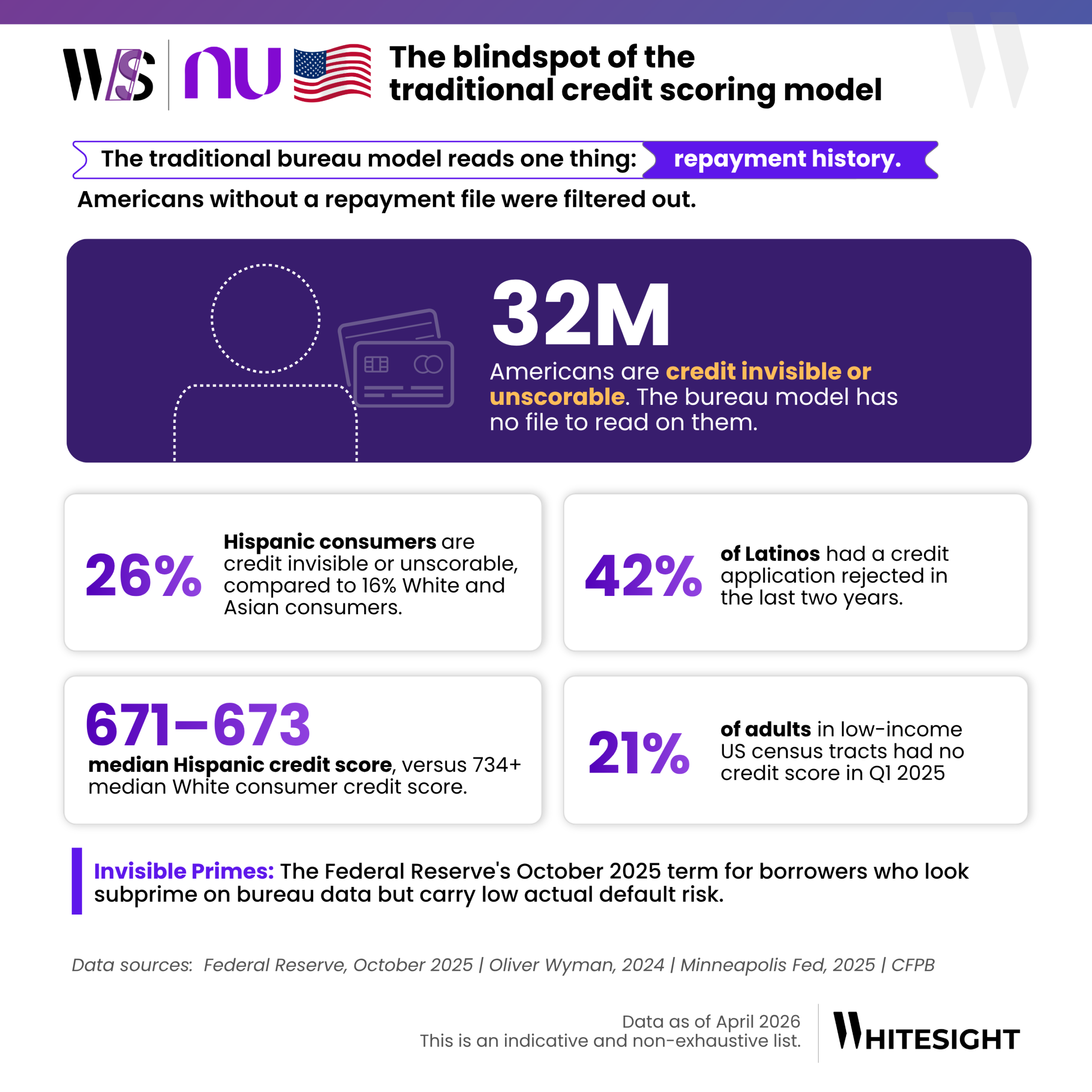
This infographic, titled "The blindspot of the traditional credit scoring model," highlights the limitations of current credit bureaus in the United States and their impact on minority and low-income populations.

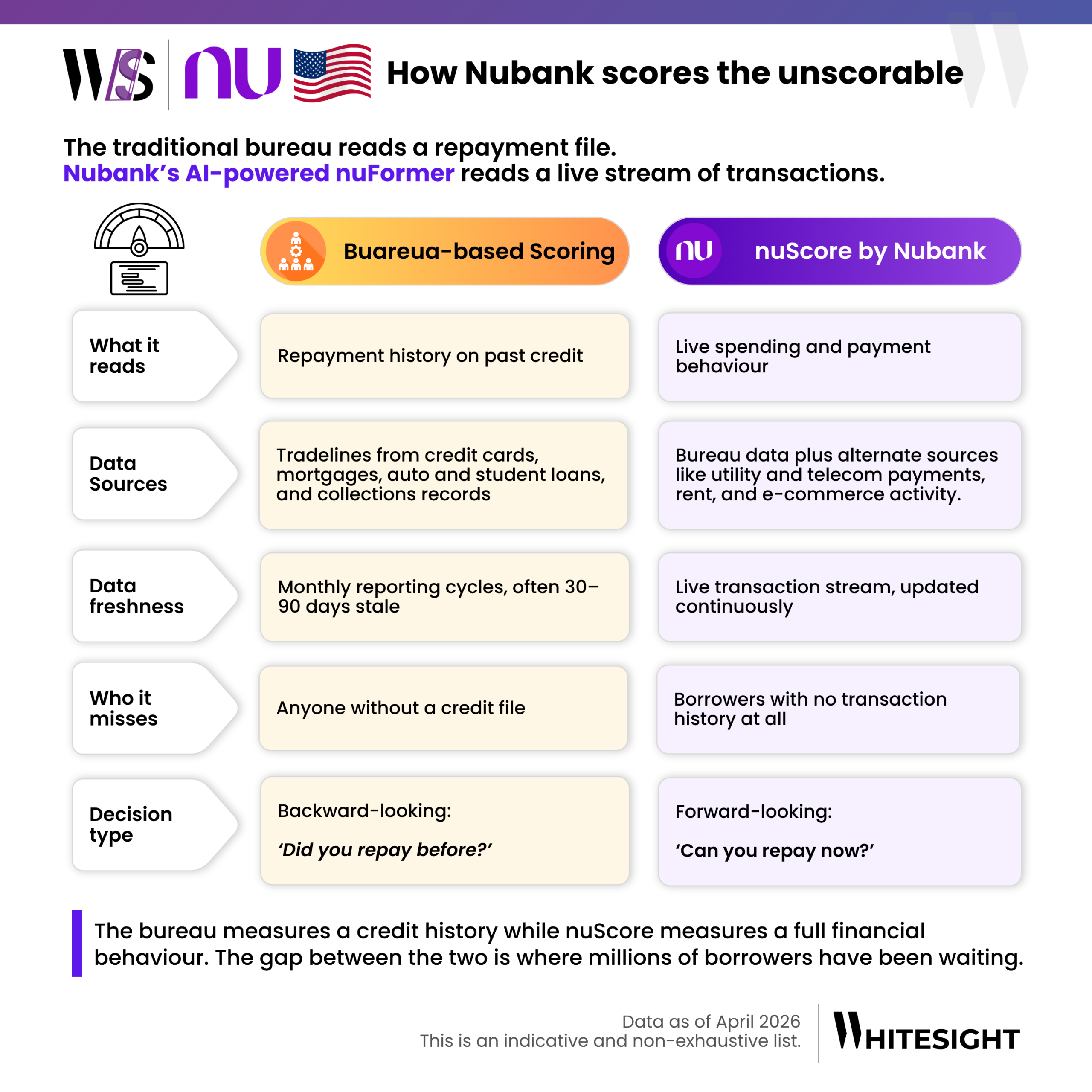
Traditional credit scoring models had no mechanism to evaluate borrowers outside that frame. Repayment history was the only signal the architecture was designed to read. For anyone who had never needed to borrow, that question had no answer. And a model with no answer defaulted to the same conclusion every time: denial.

The consequences are precise. 26% of Hispanic consumers in the US are credit invisible or unscorable, compared to 16% of White and Asian consumers. The median Hispanic credit score is 671–673, compared with 734+ for White consumers. 42% of Latinos report having a credit application rejected in the last two years.

In October 2025, the Federal Reserve gave this underserved consumer group a name: ‘invisible primes’ – borrowers who appear subprime on bureau data but carry a low propensity to default. A Harvard study found that a fintech using alternative data approved 15–30% of low-credit-score applicants rejected by traditional models, at lower interest rates.

The gap traced back to architecture. A model measuring repayment history had no mechanism to evaluate the financial behaviour of someone who had never borrowed. The system reached the only conclusion its design permitted. The scoring model reached the only conclusion its design allowed. The model was not broken. It was doing precisely what it was built to do, and that is the problem.

From charter application to conditional approval, capitalisation deadlines, and supervised operations, Nu’s U.S. journey reflects a carefully staged institutional build. This report unpacks what this timeline reveals about Nu’s long-term banking strategy in the U.S. Check out the full report now!
Report

Translating the silence of thin-file transactions

A year of transactional data about spending and earnings tells a complete story: income timing and frequency, spending discipline, and how someone manages money when things get tight. The financial narrative of a thin-file customer has always been present, written in transaction data that traditional credit scoring models were never built to read.

Traditional credit scoring models had no architecture for sequences. They converted transaction data into static feature tables, discarding the seasonal patterns, the income consistency, and the behavioural signals that distinguish a reliable borrower from a risky one. The translation layer simply did not exist.

Most banks still lack it. BCG found in May 2025 that only 25% of financial institutions have woven AI into their business strategy. The other 75% are running isolated pilots with no clear path to production.

Nubank’s position is different. 131 million customers. 83% active. Over 100 million people generate live financial behaviour every day. Vitor Olivier, Nubank’s former CTO, described the scale directly: every day, Nubank decides on whether to increase a customer’s credit limit, across hundreds of billions of individual decisions.

In June 2024, Nubank acquired Hyperplane, a Silicon Valley startup that had spent two years building self-supervised foundation models trained on first-party financial transaction data. Eighteen months later, nuFormer went into production.

WhiteSight Radar: the fintech intel pros trust 🚀

How the architecture behind ChatGPT became everyone's private banker

The transformer model, the architecture behind ChatGPT and Google Gemini, builds understanding by tracking how each element in a sequence relates to everything around it. Where earlier generation models memorised patterns in isolation, transformers learn the relationships between them. Eric Young, Nubank’s CTO, explained the connection: the same technology predicting the next word in a sentence can predict the next financial behaviour in a spending history.

nuFormer applies that logic to transaction data. Every purchase is broken into approximately 14 tokens: amount sign, amount bucket, date, merchant category, transaction type. A year of spending becomes a long sequence. The model reads a year of spending the way a language model reads a paragraph, as a connected sequence where each transaction shapes the interpretation of every other.

The first generation of nuFormer was trained on approximately 600 billion tokens. The full dataset spans trillions. The scaling roadmap targets 700 million to 1.5 billion parameters. The model improves as it reads more.

What it delivers is something that has always existed in banking, but only for the wealthy. A private banker extending credit to a high-net-worth client does not consult a three-digit score. They read the client’s financial life: income rhythm, spending discipline, behaviour through difficult periods. That judgment has always produced better credit decisions than bureau-based scoring. It was rationed by the cost of the relationship. Vitor named the shift: ‘If the mobile phone brought the bank to everyone’s pocket, AI can bring the private banker to everyone’s pocket.’

nuFormer is the mechanism. And in April 2025, Nubank gave customers a window into it, launching NuScore in Brazil, a proprietary 0-to-1000 credit score incorporating spending behaviour, savings habits, and market indebtedness alongside bureau data. Traditional credit scoring models capture repayment history. nuFormer reads the behavioural layer that history cannot summarise. nuFormer works alongside traditional credit scoring models, adding the behavioural layer that those models were never designed to see.

Supercharge your Fintech IQ with WhiteSight Radar

Join Radar for exclusive member benefits and access to expert reports, industry trend breakdowns, and insights on everything from Embedded Finance to Digital Banking, Open Finance and beyond.

Validating the model in the banking sector of a country with the tightest margins

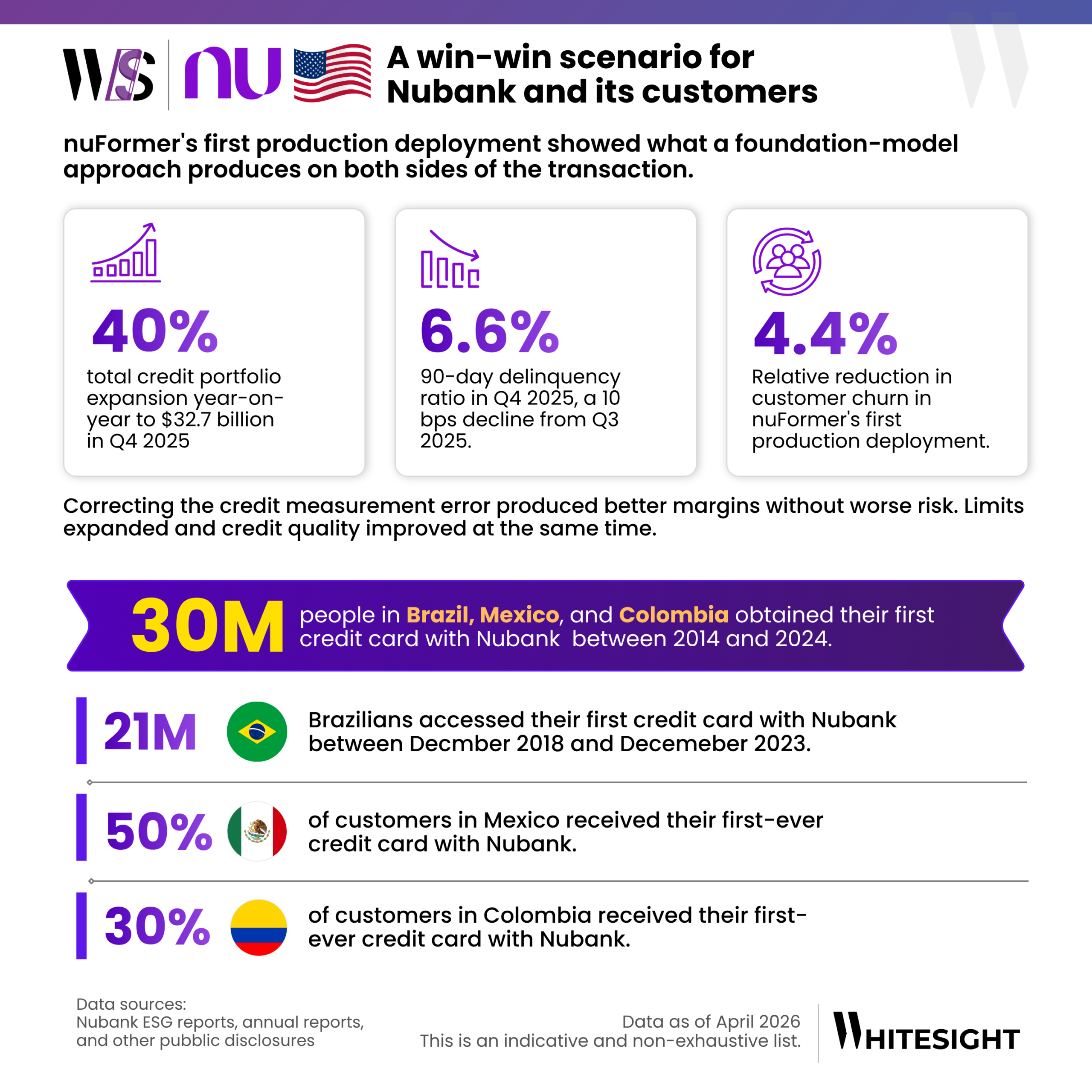
The first evidence came from Nubank’s own peer-reviewed research, a controlled production deployment with independently verifiable results. In production, nuFormer delivered a 4.4% relative reduction in customer churn against the baseline model. The joint fusion architecture, transformer embeddings combined with traditional tabular features, produced a +1.25% relative improvement in test AuC over the industry-standard LightGBM baseline. 

The business result followed in Q4 2025. Nu posted the largest quarterly credit card market share gain in Brazil in ten quarters, directly attributed to nuFormer. The Q4 numbers represent the earliest signal from credit lines that customers are only beginning to use. The full financial impact of Q4’s market share gain continues to build into subsequent quarters.

The financial outcome sharpened that picture. Q4 2025 net interest income reached $2.8 billion, up 55% year-on-year. Adjusted net interest margin expanded 0.6 percentage points to 10.5%. Bloomberg attributed part of that expansion to nuFormer’s deployment. At the same time, the 90-day delinquency ratio fell 0.1 percentage points to 6.6%. Credit limits expanded, and credit quality improved simultaneously. That is what correcting the measurement error actually looks like in a profit and loss statement.

Turning a systemic blind spot into a strategic moat

Nubank arrives in the US with conditional OCC approval, 4–5 million LatAm corridor customers already transacting, and a credit model trained on more behavioural data than any US incumbent has assembled for this segment. In Mexico, roughly half of all Nu customers received their first-ever credit card through Nu. The thin-file Latino corridor is the same dynamic in a new geography, a population generating readable financial data for years, without a model capable of reading it.

Cristina Junqueira, Nubank’s co-founder and US CEO, had a hard time getting a credit card in Miami after relocating. A billionaire with a decade of banking expertise turned away by a system that asked the wrong questions. She is now building, in the same city, the model that would have approved her. The same model that is already in production in Brazil, expanding to Mexico, and is ready to be deployed to make credit decisions in the US from day one. 

Get Unlimited Access to Strategy Playbooks
of Fintech Pioneers! 🚀

Unlock the deep dives into the winning strategies of Nubank, Monzo, Revolut, and more with a WhiteSight Radar Membership.

Be the First to Know About the Next Big Fintech Strategies!

Don’t miss out on the next big fintech wave! Follow us on LinkedIn and subscribe to our Future of Fintech Newsletter to be the first to know about the Next Big Fintech Strategies.


    Authors

    Founder & CEO | sanjeev@whitesight.net

    Sanjeev is a fintech aficionado who loves to explore the depths of the industry as much as he loves to explore the depths of the ocean in his scuba gear. He is the founder and CEO at WhiteSight, bringing a wealth of research and advisory experience to the fintech world.

    Senior Research Associate

    Risav is a senior research associate at WhiteSight, where he spends his days navigating the complex fintech landscape and poring over market trends. When he's not decoding the world of fintech, you'll find this sports fanatic decoding the perfect curveball on the football field.

    Already a subscriber? Log in to Access

    Unlock this blog

    Gain exclusive access to this blog alone.

    Radar Subscription

    Select a membership plan that resonates with your
    goals and aspirations.

    Not Ready to Subscribe?

    Experience a taste of our expert research with a complimentary guest account.

    We publish new research regularly. Subscribe to stay updated.
    No spam. Only the best in class fintech analysis.


      Related Posts
      Infographic overview showing different types of loans given by Nubank in Latin America, like FGTS Birthday Withdrawal Anticipation, Investment-backed Loans, and Payroll Loans for federal employees, retirees, armed forces, state and municipal employees, and private sector.
      Complimentary Research
      Infographic design showcasing business banking services in Brazil from Itaú, Nubank, Inter, and C6, highlighting offerings like accounts, cards, payments, and POS solutions.
      Complimentary Research
      Table comparing retail banking services in Brazil between incumbent bank Itau and digital banks Nubank, Inter, and C6 Bank, showing checkmarks for available services.
      Complimentary Research
      A timeline infographic depicting the regulatory and market-driven adoption of open finance in the UAE from 2020 to 2025.
      Complimentary Research
      Infographic showcasing C6 Bank's ESG Impact, highlighting key metrics in environmental, social, and corporate governance initiatives.
      Complimentary Research
      Infographic showcasing a comparison of key metrics for leading Brazilian digital banks: Itaú, Nubank, Inter, and C6 Bank. Data includes client base, revenue, profitability, and more.
      Complimentary Research
      Select currency
      WS_Logo_-for-White-BG-01.png