The Great SME Mismatch and the New Challengers Fixing It
Small and medium-enterprise (SME) banking is the original fintech origin story: one of the most important customers, treated like the world’s most inconvenient ones. Their business runs in real time: orders, payroll, inventory, refunds. Yet, the traditional bank experience still too often starts with a polite request for last year’s PDFs and a side of collateral.
That mismatch matters because SMEs are not a niche. Globally, SMEs make up 90%+ of all businesses, drive ~70% of employment, and contribute ~50% of GDP.
Incumbents have long known that SMEs matter. The challenge has been translating that awareness into service at scale. Why? Because most incumbents are optimised for two extremes: standardised retail at scale, and well-documented corporates with formal histories. SMEs live in the messy middle – often “data-thin” on paper, yet rich in real-time insights across POS, eCommerce, invoicing, and payment flows.
And even banks admit the infrastructure is a constraint. A 2024 IBM survey flags lack of modularity in core banking systems (53%) and inadequate API standards (52%) as major barriers to evolving SME offerings.
Meanwhile, SMEs moved on. The pandemic accelerated a behavioural reset: IDC notes over 90% of SMBs increased their reliance on technology, making digital adoption “a matter of survival”. As they go digital, expectations are rising. They now demand seamless, omnichannel experiences from financial providers. “Banking basics” like fast onboarding, low-friction transactions, and real-time decisions stop being differentiators and become table stakes.
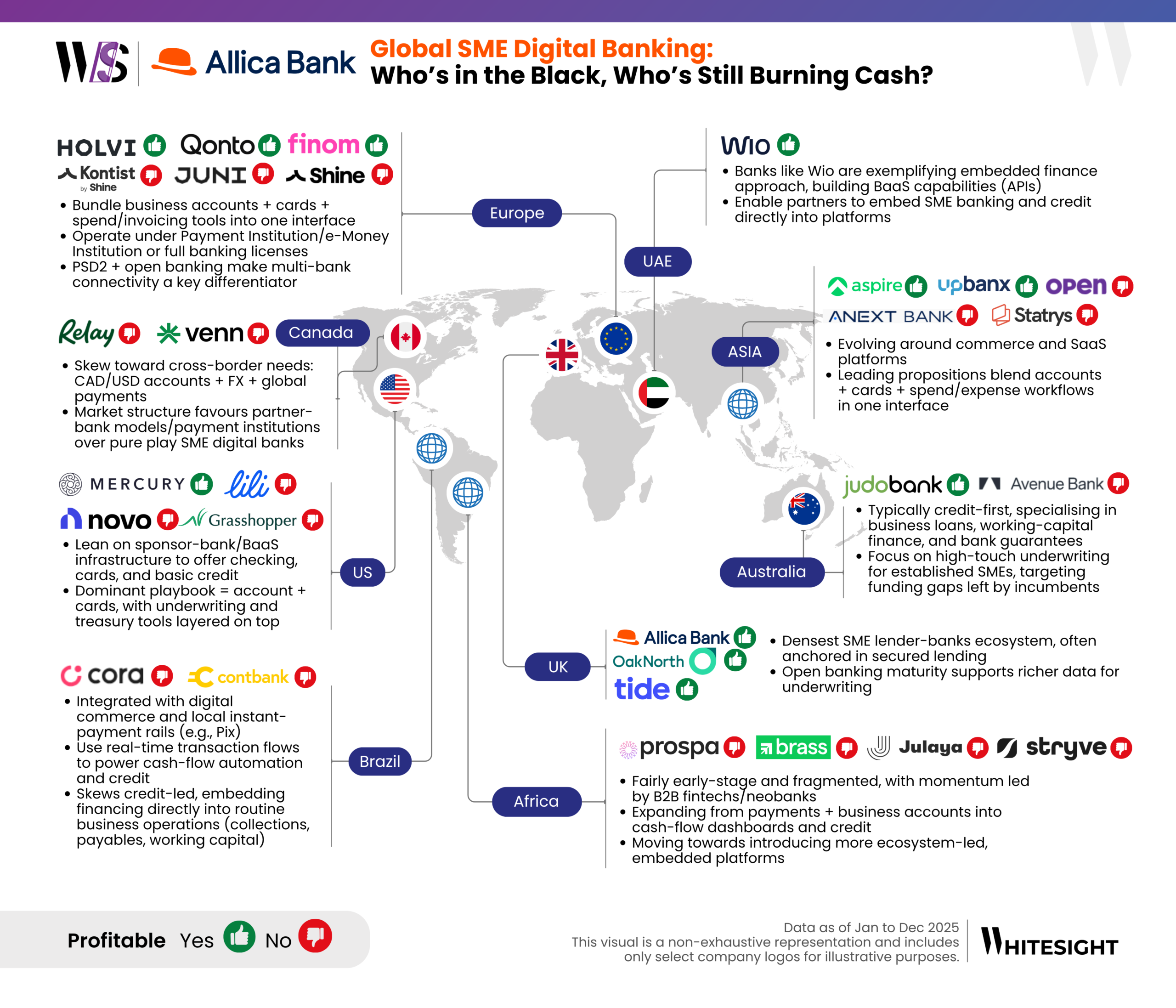
This is exactly where a new generation of SME banking models has emerged, because the gap is now too visible, too expensive, and too ripe for unbundling. SME digital banking is diverging across markets – API-powered SME stacks in mature economies, and workflow-native models in emerging markets are creating entirely new playbooks. Our report Reimagining Digital Banks for SMEs with Zazu explores this distinction in further detail.
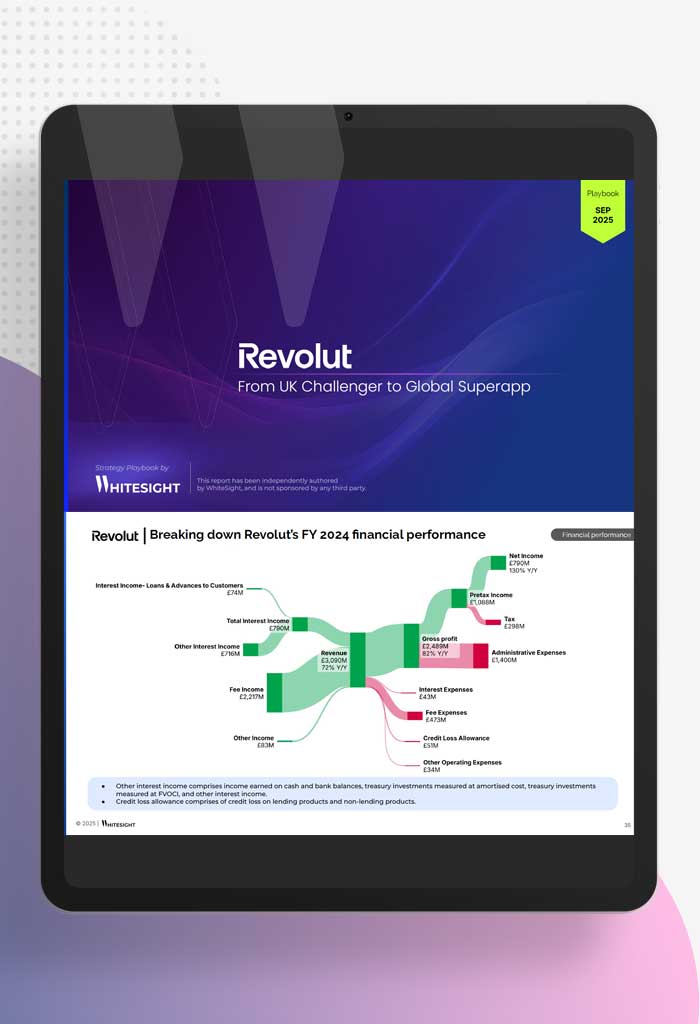
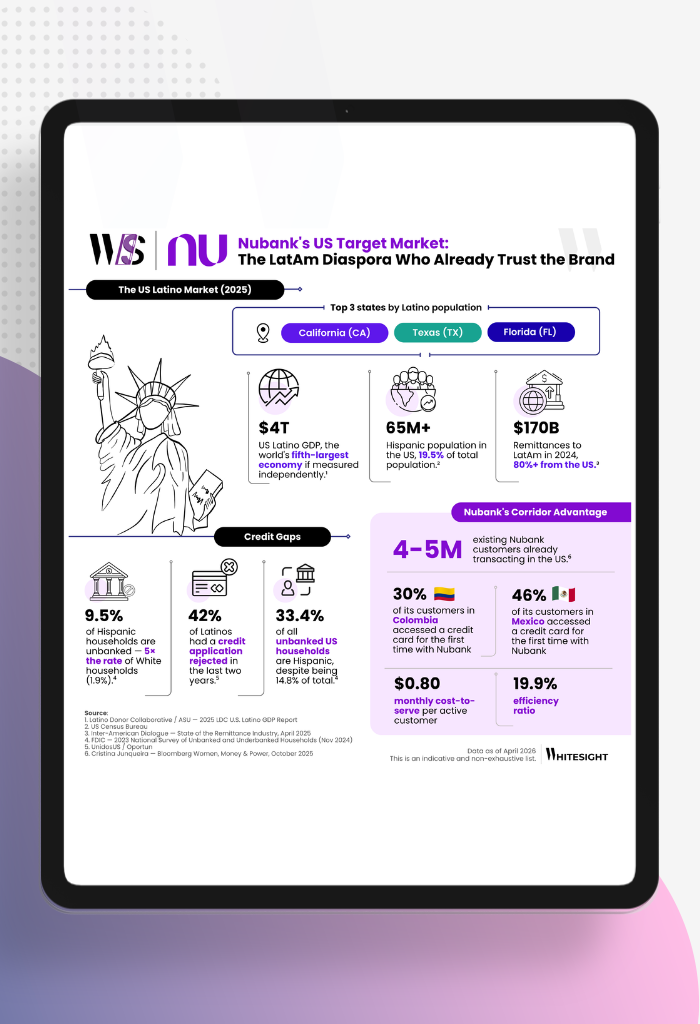
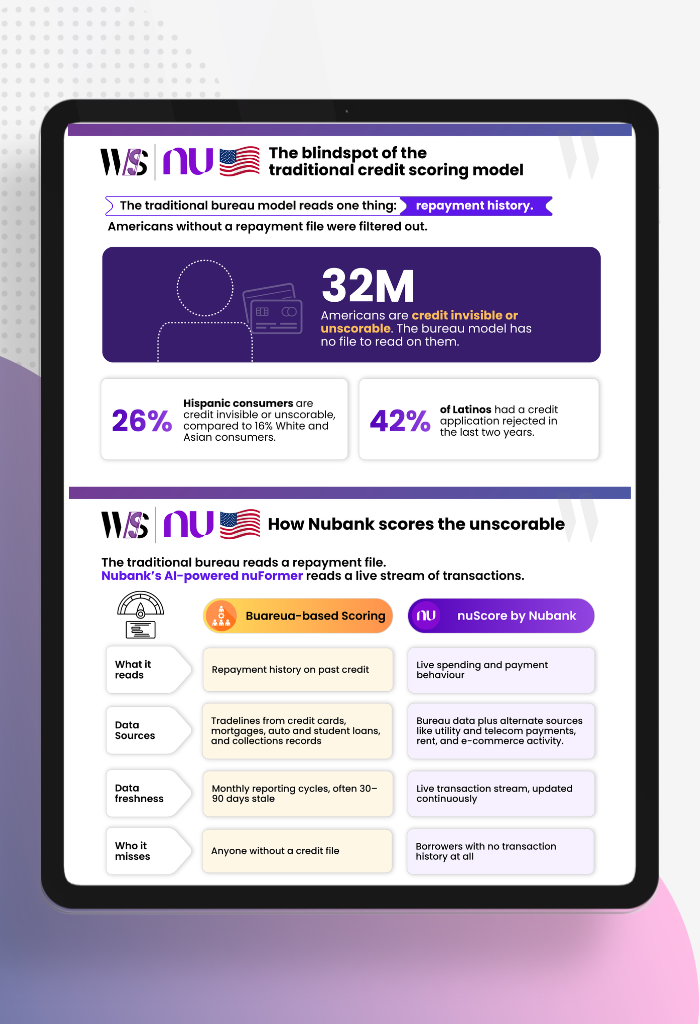
On one side, players from adjacent strongholds have expanded to cater to SMEs. This includes retail digital banks that are layering business banking tools onto existing infrastructure like Revolut, which has launched a business account that allows SMEs to manage their finances, send and receive payments, and access a range of other financial tools. Its SME push is a moat strategy, using merchants and business tools to build recurring revenues, something we explore in-depth in our Revolut: From UK Challenger to Global Superapp deep dive. Similarly, Nubank has launched a range of credit products, such as overdrafts and loans, that are tailored to the needs of SMEs. Its SME expansion shows how retail-first players port their distribution advantage into business banking by bundling banking, lending, payments, and financial management tools. Our work on Nubank’s SME Expansion (4 Key Offerings) decodes this further. Others like Allica Bank, OakNorth, and Qonto were built SME-first. These digital banks design workflows with multi-user accounts, real-time cashflow visibility, integrated payments, and credit built on operating data, whether via a licence or sponsor-bank/BaaS rails.
And adoption is already visible in financial services. A 2025 OECD D4SME survey reveals that 58% of SMEs use digital financial services from fully digital fintech providers, led by online banking (43%) and payment processing (42%).
But with this comes the question of the hour: it’s one thing to serve SMEs, can challengers do it profitably, at scale, and through cycles?

Profit Is the New Proof of Model
Profitability is the industry’s new stress test. For a long time, it used to be a future reward for growth; now it’s a survival requirement. High inflation and elevated rates raise the cost of capital and credit, making low-margin models harder to defend. VC funding has cooled, shrinking the runway for loss-making expansion; and regulators want proof that “growth” is backed by a durable business model. Definitions of profitability vary too. While some players describe it as net profit after tax, others sometimes cite it as profit before tax, operating profit, or even positive EBITDA.
Historically, durability by digital banks has been hard to reach because many ran on thin margins. They competed on price, incentives, and higher deposit rates while monetisation lagged. The missing ingredient was often a clear revenue proposition, and in most cases, diversified revenue streams – especially lending and interest-linked income.
What’s changed now is that a meaningful share of digital banks are clearing that bar. 61% of the world’s top 100 digital banks delivered full-year profitability in 2025 (up from 48% in 2024), even as the broader global break-even ratio remains below 25%.
For this story, it’s interesting that some of these profit paths are now showing up in SME-focused digital banks too, because SMEs generate high-frequency financial activity (payments, balances, FX, cards), and because business models around lending and deposit economics can scale quickly.
Monzo understood that adoption depended on the frequency of use. Features like Pots turned banking into behavioural design. By letting users “earmark” money for goals, Monzo bridged emotion with disciplined saving. By FY22, over 300K Pots were being created each month.
Yet Monzo’s true inflection point came when it moved beyond managing money to making money work. Instant Access Savings Pots, launched in 2020, were the catalyst. By offering up to 3% AER via partner banks, Monzo built a dual engine of trust and deposits. Within a year of launch, Instant Access balances exceeded £7.7B, turning idle funds into a low-cost funding source for future lending.
The Routes to Profit in SME Digital Banking
SME-focused digital banks are racing to become profitable for four very practical reasons:
- profit is the clearest signal to investors that the model works (and deserves more capital);
- it strengthens solvency, which matters when you’re asking SMEs to trust you with real deposits;
- it satisfies regulators looking for sustainable, license-worthy business models;
- and it unlocks the ability to fund better products, because lending margins and retained earnings pay for everything from sharper pricing to deeper “share-of-wallet” stacks (accounts, savings, credit, and workflow tools).
Globally, SME-digital bank profitability tends to cluster into a few repeatable paths:
- UK + Australia = lending-led profitability: The players here treat lending as the core business, and then build the funding base (deposits, savings products, broker-led origination) to make that engine durable through cycles. The key trend is discipline: growth is paced to protect credit quality and capital, which is increasingly important as digital banks take a more cautious stance on risk overall.
- Europe = bundled stacks + recurring revenues: SME players here tend to win by becoming the daily operating layer (account + payments + admin workflows) so revenue recurs even before credit meaningfully scales. They usually lock in retention via bundled utility, monetise through fees/subscriptions and transaction margins, then add lending once distribution and data improve.
- Asia + US + Middle East: platform economics, but three different levers: The shared thread across these markets is distribution efficiency. Profitability is driven by sitting inside high-frequency SME activity (cards, payouts, FX, treasury balances) and capturing repeatable margins at scale. The distinction is the dominant lever. In Asia, many profitable players monetise via integrated spend and treasury workflows (multi-currency accounts, cards, FX, expense controls) where revenue rises with usage. In the US, profitability is accelerated by deposit-linked interest income (particularly in higher-rate environments). In the Middle East, a BaaS-ready, low-cost digital stack helps scale deposits and accounts efficiently.
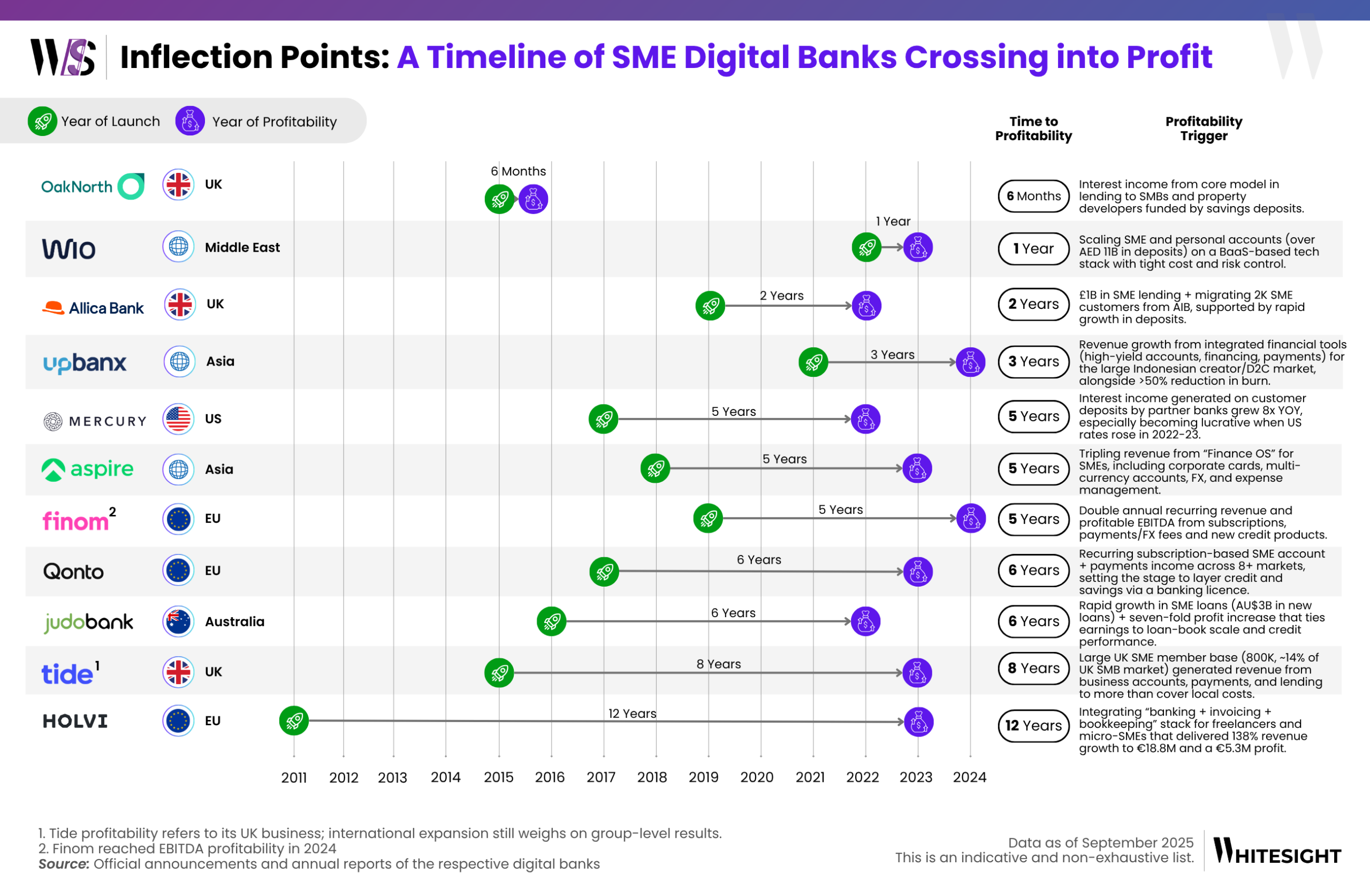
Stepping back, the timeline of profitability suggests the typical profitable SME digital bank still takes around ~5 years from launch to cross into profit, with a handful of standouts doing it in ~1–2 years. That compression mirrors the broader digital banking arc: interest income remains the primary revenue source, but banks have grown more cautious on lending risk (average loan-to-deposit ratio: 71% in FY22 → 69% in FY23). And that leading second-generation players are now hitting break-even closer to ~2 years than the historical ~5–6.
Among the standout banks hitting profitability at that faster end of the curve is Allica Bank, a UK SME digital bank whose path to profit is as deliberate as it is rapid.
The Three Part Model Behind Allica’s Fast Profit
The UK is a deceptively large SME market: 5.5M SMEs make up 99.8% of the business population. Yet their day-to-day reality is defined by practical stressors: growing sales/revenue (35%), increasing competition (29%), and managing cashflow (25%) rank as top challenges.
- At the same time, behaviour has moved decisively online. Weekly usage sits at 54% for mobile banking and 52% for online banking, and 70% of UK business leaders would consider a business bank account with no branches.
- However, access to finance hasn’t kept pace with digital expectations. Loan rejection rates have risen from ~5–10% to ~40%, and 77% of SMEs say they’d rather accept slower growth than borrow to grow faster.
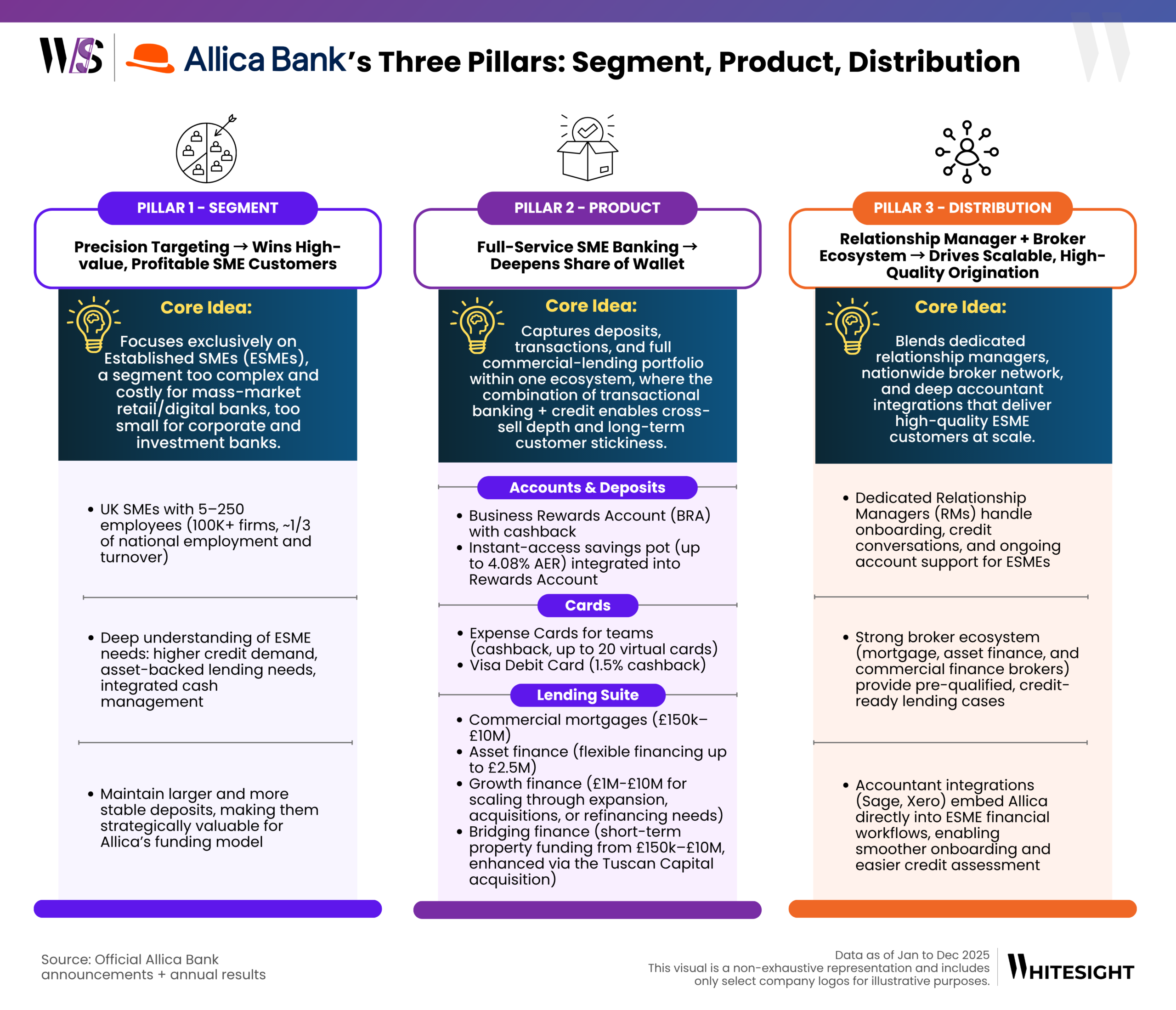
This is the gap Allica walked into: a huge, digitally ready market that still feels underserved by legacy credit processes and “one-size” business banking. Allica’s wedge was lending: it began lending in March 2020 and reached monthly profitability by June 2022, an unusually fast arc for a digital bank. To understand how Allica reached profitability so quickly, it helps to look at its model through three lenses: who it serves, what it offers, and how it scales distribution:
1. Target Segment:
Allica’s speed to profitability starts with who it serves: Established SMEs (ESMEs). These businesses have 5–250 employees, a typical segment size of 100K+ firms, which represent a third of UK employment and turnover. They bring higher credit demand, repeat asset-backed borrowing needs (property, assets, working capital), and larger, stickier deposits. For incumbents, though, ESMEs sit awkwardly between their two core markets: millions of micro-SMBs on one side and large corporates on the other. Yet, they are a highly attractive segment for revenue, funding, and balance-sheet economics.
2. Product:
Allica launched with business mortgages. It then expanded into savings and asset finance, building specialist lending revenue via while assembling the plumbing for a full relationship. The strategic unlock was the Business Rewards current account for ESMEs. Launched in 2022, it offers no monthly fees, up to 1.5% cashback on eligible card spend, and up to 4.08% AER (variable) on instant access savings. From there, the account has become the central operating hub: day-to-day transactions + a high-yield savings pot + card economics, all living in one place. This way, the bank sees more of the customer’s financial life, more often. As Nida Sattar, Head of Product (Payments), puts it: “Business current accounts and transactional banking naturally provides more touchpoints… enabling us to cultivate and grow relationships with customers.” This enables Allica to: A) originate more lending from the same customer base; B) fund lending more efficiently as deposits from the core account reduce the cost base of lending.
3. Distribution:
The business account is backed by UK-based relationship managers who help ESMEs with higher-stakes financing decisions across commercial mortgages, asset finance, growth finance, and bridging loans. To scale beyond what an in-house team could source alone, Allica leans on a strong partner network. This includes commercial finance brokers, who make broker-led cases smoother while keeping credit decisions responsive. It also extends distribution via accountants and enterprise partners. It has built dedicated accountancy partnerships and integrated tools like Sage and Xero to sync transactions and reduce manual work. Through its enterprise partnerships, Allica works with fintech platforms, professional services firms, and trade associations, so partners can embed Allica’s products into their own offerings or integrate their platforms to synchronise data.
Two Roads to UK SME Digital Banking Profitability
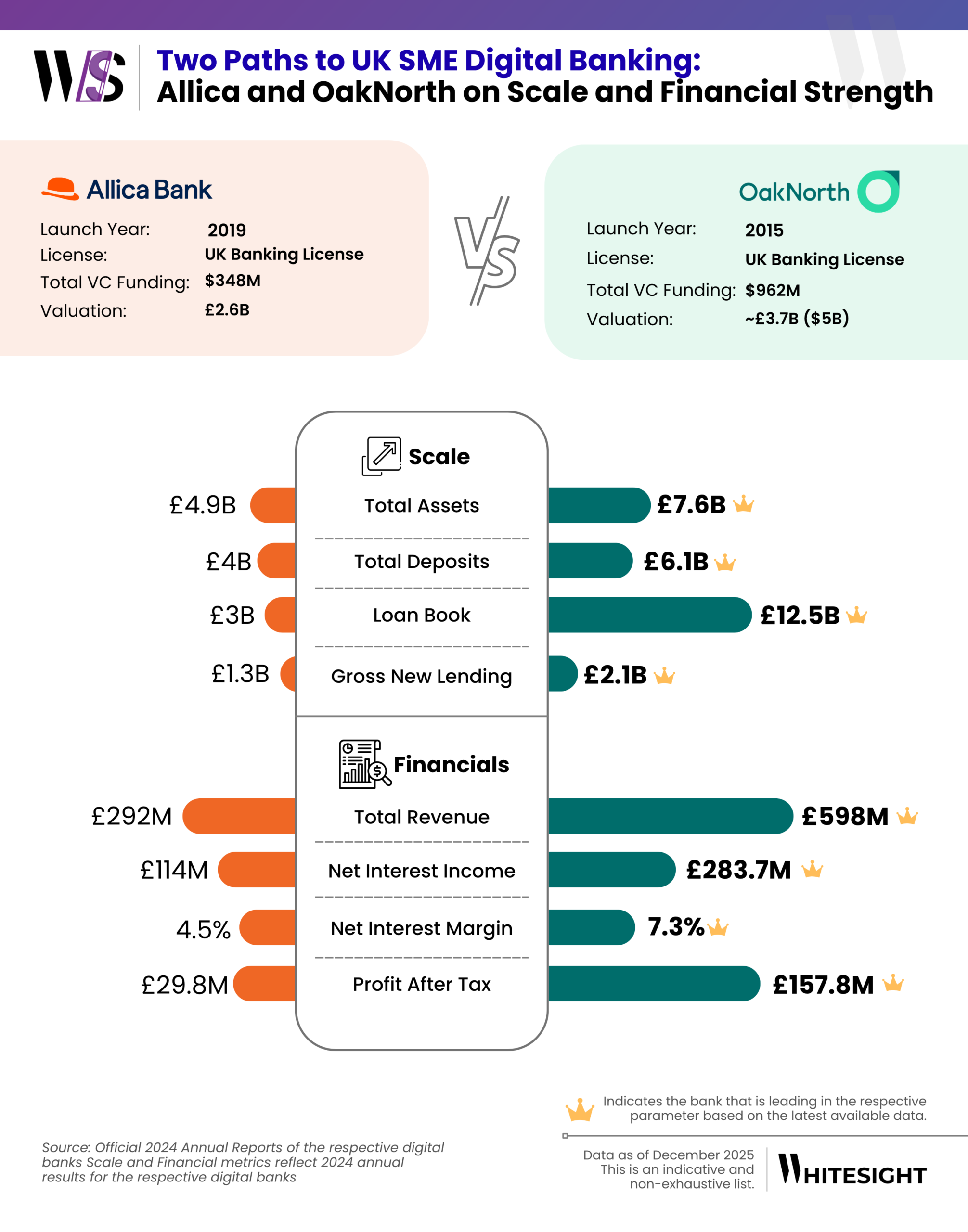
Another UK SME digital bank known for speedy profitability is OakNorth. Like Allica, it targets a segment that sits in the awkward middle for incumbents. But its definition is different: OakNorth focuses on the UK’s “missing middle” – growth-oriented mid-sized businesses typically with £1M-£100M turnover. They are often underserved by traditional banks despite being economically important. OakNorth is a case study in building a tech-first, credit-led challenger that cracks profitability by going deep on mid-market lending economics and execution. We explore the full playbook in our report OakNorth’s Challenger Bank Playbook.
Where Allica is building a full relationship around the business current account (cashback + high-yield savings + RM support) to become the day-to-day bank for ESMEs, OakNorth is much more credit-led. It is built around delivering fast, flexible debt finance for growth and expansion, with banking services designed to support that lending relationship. That difference shows up in the shape of the two businesses: Allica’s model is balance-sheet + relationship depth, while OakNorth looks like a scaled specialist lender with a larger lending engine.
A quick snapshot from 2024 underscores the contrast: OakNorth’s loan book (£12.5B) is ~4x Allica’s (£3B) and it runs a higher net interest margin (7.30% vs 4.50%), while both operate with UK banking licences.
In the end, both challengers show two profitable paths, but with two different centrepieces. Allica is optimising for “primary bank” status in ESMEs (transactions → deposits → lending). Meanwhile, OakNorth is optimising for “specialist growth lender” status in the “missing middle” (lending depth → repeat expansion financing).
Supercharge your Fintech IQ with WhiteSight Radar
Join Radar for exclusive member benefits and access to expert reports, industry trend breakdowns, and insights on everything from Embedded Finance to Digital Banking, Open Finance and beyond.
Profit Built for the Long Haul
Allica’s next chapter is less about inventing a new playbook and more about industrialising the one that got it to profitability quickly. On the product side, it’s leaning into open-banking-powered current account funding, partnering with Yapily so SMEs can top up their Allica current account seamlessly and then move funds into an instant-access savings pot when needed. On the credit side, it’s widening beyond classic term lending into working capital and embedded finance via its acquisition of Kriya, with an ambition to advance £1B of working capital finance to SMEs over the next three years and accelerate progress toward 10% market penetration by 2028 (with an eye on future international expansion).
The lesson for other SME digital banks already on the path to profitability: pick a segment you can serve end-to-end, make the current account the relationship hub, build repeatable credit, and invest early in distribution channels that earn trust.
Be the First to Know About the Next Big Fintech Strategies!
Don’t miss out on the next big fintech wave! Follow us on LinkedIn and subscribe to our Future of Fintech Newsletter to be the first to know about the Next Big Fintech Strategies.
Authors
Sanjeev is a fintech aficionado who loves to explore the depths of the industry as much as he loves to explore the depths of the ocean in his scuba gear. He is the founder and CEO at WhiteSight, bringing a wealth of research and advisory experience to the fintech world.