



You buy something online, tap pay, and the payment is declined. The money is there, the card is yours, nothing is wrong. A fraud filter decided you looked risky and said no in half a second, so you gave up and bought elsewhere. The merchant never knew you were there. It only knows it lost a sale.
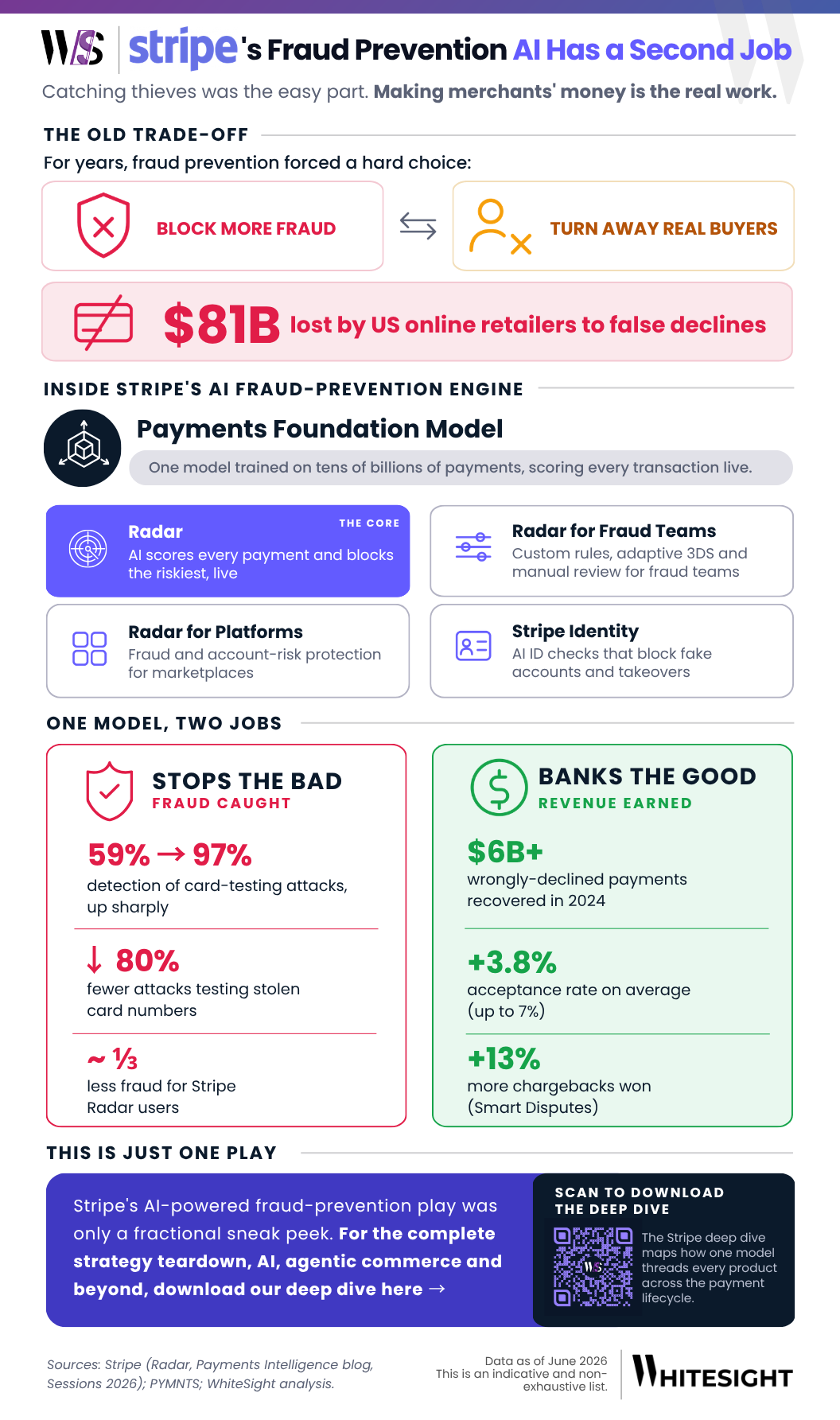
That mistake is a false decline, and it scales. False declines cost US online retailers an estimated $81 billion a year, more than the fraud that slips through. The thieves a system catches are visible and countable; the honest customers it wrongly turns away are invisible, and they cost more.
For as long as the internet has sold things, businesses fought fraud on one instinct: build a higher wall. Block more, lose less. But a wall cannot tell a thief from a customer in a hurry, so every notch tighter costs more legitimate revenue than it saves. That trade-off, safety against sales, became the accepted price of selling online.
Stripe Has Already Seen That Card
Stripe questioned it. The company processes online payments for millions of businesses and handles more than $1.9 trillion a year. Its question was a different one: how to approve more of the good customers the wall turns away without letting the bad ones through. That needs something a wall lacks: the ability to read a single payment and tell a first-time buyer from a thief using a stolen identity.
Radar, Stripe’s fraud prevention solution, has learned from the network for over a decade. Its advantage is what it has seen. When a card reaches a Stripe checkout, there is a 92% chance Radar has seen it before somewhere on the network, at another merchant or in another country. A single business sees only its own customers, so a card testing stolen numbers across a hundred sites looks new to it. Radar sees all hundred at once. It scores each payment against hundreds of signals in real time, which lets it block the riskiest and cut fraud by roughly a third on average. Stripe runs a second AI product beside it, Stripe Identity, which matches a customer’s government ID to a live selfie to stop fake accounts before they ever transact. But even with that reach, seeing is not understanding, and the newest payment attacks no longer match known patterns.
Then Stripe Built a ChatGPT for Money
So Stripe changed how the intelligence works. Radar had relied on a stack of separate, hand-built models, each tuned to a known trick, with others handling approvals and disputes. Stripe replaced that with one large model trained on tens of billions of transactions: its Payments Foundation Model. The principle mirrors a large language model. Where ChatGPT learned language from billions of sentences, this model learned the structure of normal payments from tens of billions of transactions. It compresses each payment into a signal that captures patterns no human could track.
The first test was card testing, where criminals run thousands of small charges to find which stolen cards still work, hidden inside large merchants’ traffic. Radar’s older models caught 59% of these attacks on its largest users. With the foundation model, detection rose to 97% ‘overnight,’ according to Stripe’s head of applied machine learning, Gautam Kedia, with no rise in false declines. Industry-wide, these attacks are climbing; on Stripe, they are down 80%.
Where Catching Fraud Translates to Making Money
How Stripe measured that result is the part most coverage missed. A model precise enough to identify a fraudster is precise enough to clear a genuine customer, so it blocks more fraud and approves more good payments at the same time. Stripe reports that second effect on revenue. Authorization Boost, which optimises approvals, recovered more than $6 billion in wrongly declined payments in 2024 and lifts acceptance rates by 3.8% on average. Smart Disputes helped merchants such as Vimeo and Squarespace win 13% more chargebacks. Radar cut its users’ dispute rates 17% in a year, while industry ecommerce fraud rose 15%.
Most of those figures measure revenue earned. The same model that flags a fraudster also clears a good customer and contests a dispute, which is why Stripe is rolling it across its products to grow revenue. Fraud was where Stripe proved the model. It did not intend to stop there.
Supercharge your Fintech IQ with WhiteSight Radar
Join Radar for exclusive member benefits and access to expert reports, industry trend breakdowns, and insights on everything from Embedded Finance to Digital Banking, Open Finance and beyond.
This Model is Already Deciding Whether to Trust You
You have almost certainly been on the receiving end of this without realising it. Every online payment that simply worked, especially the ones that, a few years ago, would have been wrongly declined, passed through a model deciding in half a second that you were worth a yes. You never noticed; neither did the merchant who kept the sale. That silence is the design. And the same model is now learning to make that call for the AI agents starting to shop on our behalf, which is why the businesses still quoting Stripe’s fraud headline are watching the wrong number.
Be the First to Know About the Next Big Fintech Strategies!
Don’t miss out on the next big fintech wave! Follow us on LinkedIn and subscribe to our Future of Fintech Newsletter to be the first to know about the Next Big Fintech Strategies.
Authors
Risav is a senior research associate at WhiteSight, where he spends his days navigating the complex fintech landscape and poring over market trends. When he's not decoding the world of fintech, you'll find this sports fanatic decoding the perfect curveball on the football field.