WhiteSight

Decoding AI-dyen’s Strategy from Payment Optimisation to Agentic Infrastructure

Table of Contents

When was the last time you thought about the code that verifies your identity during checkout? You didn’t. You just expected it to work. Most payment processors are still stitching together acquired systems built in different decades, on different codebases, with different databases.  As Marc Andreessen predicted, “software is eating the world.” In payments, that world is being consumed faster than anyone anticipated. Every transaction now carries more intelligence than most checkout pages reveal. Most payment processors bolt AI onto fragmented, acquired systems. Adyen took a different path. The company built a single global platform from scratch, which it calls the “build-over-buy” philosophy. This architectural choice now means that for a typical retail merchant on Adyen, there is a high chance the platform has already seen and verified the shopper before the merchant even knows they’ve arrived. The AI knows the customer better than the merchant does, and the merchant benefits from day one.

AI Is Becoming the Economic Engine

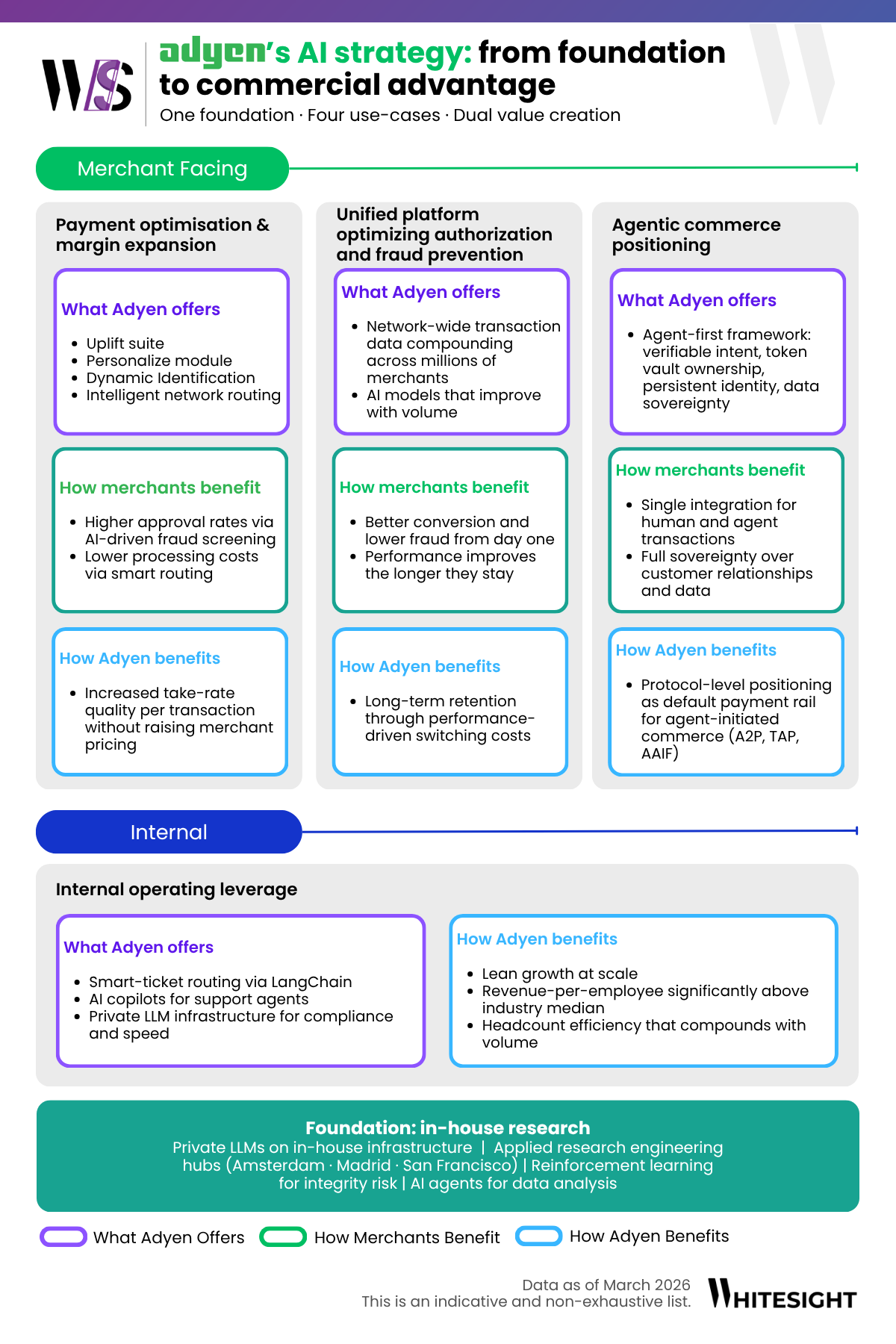
AI at Adyen serves three goals: increase authorisation rates, reduce payment costs, and power agent-led commerce. The company builds AI capability from the foundation up. Private LLMs, applied research hubs, and proprietary ML models form that foundation. Four distinct use-cases sit on top of it. Three are merchant-facing, designed to drive measurable commercial outcomes. One is internal, designed to compound operating efficiency. This breakdown decodes that strategy across all four.

Foundation: In-house AI research and private infrastructure

Merchant-facing use-cases:

  • Payment optimisation and margin expansion
  • Merchant lock-in infrastructure
  • Positioning for agentic commerce

Internal use-case:

  • AI for internal operating leverage
Flowchart of Adyen’s AI strategy showing merchant-facing tools, internal operating leverage, and in-house research foundations.

Foundation: In-house AI research and private infrastructure

Adyen maintains a dedicated internal AI research team that builds its own machine learning models rather than outsourcing core decision systems. This includes developing contextualised models, hosting LLMs on private in-house infrastructure, and integrating AI directly into payments and risk decisioning. The company runs applied research engineering hubs in Amsterdam, Madrid, and San Francisco. Their work focuses on reinforcement learning for integrity risk and AI agents for data analysis.

Merchant-facing use-cases:

Use case 1: payment optimisation and margin expansion

Adyen’s embedded finance strategy is easiest to understand as a progression. Enterprise-grade infrastructure sits at the core, platforms turn it into an operating layer, and SMBs experience the result inside their day-to-day software.

For decades, merchants had to choose between three conflicting goals: maximising conversion, minimising fraud, and lowering costs. Boosting one usually damaged the others. Tighter fraud rules blocked legitimate customers. Cheaper processing routes had lower approval rates. Merchants were stuck making trade-offs with no way to optimise the full payment funnel at once.

  • Recognising the shopper before they click pay:

In February 2026, Adyen expanded Uplift with Personalize, a module that adapts the checkout page in real time for each shopper. Traditional checkouts are static; every customer sees the same payment methods in the same order, regardless of their history or preferences. Adyen’s research found that 37% of shoppers abandon a purchase if the process takes too long.

Personalize works through what Adyen calls Dynamic Identification. When a shopper reaches checkout, the system cross-references their signals, device, location, browser, and card token against Adyen’s network-wide transaction data. Within milliseconds, it determines who the shopper is, what payment method they’re most likely to use, and how much security friction they actually need. A returning customer with a clean history might see Apple Pay at the top and skip 3D Secure entirely. A first-time visitor from a high-risk location might see additional verification. The checkout configures itself before the customer begins typing.

This also works in the merchant’s favour in terms of cost. Not all payment methods carry the same processing fees. When a shopper is equally likely to use a debit card or a credit card, Personalize presents the cheaper option more prominently. This reduces the merchant’s transaction cost without adding friction for the customer. As Carlo Bruno, Adyen’s VP of Product, puts it: “Personalize achieves this balance by using Dynamic Identification to recognise shoppers instantly. This allows us to tailor the journey from the very first step.”

  • Filtering fraud without blocking real customers:

Once a shopper clicks “pay,” the transaction enters fraud screening. Traditional fraud prevention relies on manual rules, written by human analysts and applied uniformly to every transaction. “Decline anything above $500 from a new account.” “Flag all transactions from certain countries.” These rules cast a wide net, but they inevitably catch legitimate customers alongside actual fraudsters.

Uplift replaces this with AI models that evaluate each transaction individually, weighing hundreds of signals in real time to distinguish genuine shoppers from synthetic fraud. Because Adyen has already seen most of the shoppers through other merchants on its platform, the system starts with a baseline of trust. The models learn continuously from every transaction across the network, adapting to new fraud patterns without waiting for a human analyst to write a new rule. Pilot enterprise customers reduced their manual risk rules by 86% on average, with 35% eliminating them. False positives, legitimate transactions incorrectly blocked, dropped by 42%.

  • Converting more transactions into successful sales:

Smarter fraud screening feeds directly into higher conversion. When the system correctly identifies a legitimate shopper, it can reduce unnecessary security steps. These include skipping 3D Secure challenges, avoiding redundant verification, and fast-tracking approval. The shopper experiences less friction. The merchant makes more sales. Uplift has helped over 6,500 businesses achieve an average conversion rate 1.19% above industry baselines, with some merchants seeing gains as high as 6%.

  • Routing every transaction through the cheapest viable network:

Once a transaction is approved, it needs to travel through a processing network to reach the shopper’s bank. Each network, Visa, Mastercard, STAR, NYCE, PULSE, Accel, charges different fees and has different approval rates. These depend on the card issuer, the transaction type, and the merchant category. Before Uplift, most merchants either defaulted to premium networks or used basic, least-cost routing.

Uplift’s routing AI evaluates each transaction individually, factoring in the card issuer’s historical behaviour on each network, the fee structure, and the transaction characteristics. It then selects the route that minimises cost without sacrificing approvals. In its first year, Uplift helped businesses lower payment costs by 9.4% on eligible traffic.

  • Reshaping the economics of debit:

A standout application of this routing intelligence is Intelligent Payment Routing for US debit. Since the Fed’s 2023 clarification, US regulation requires every debit card to work on at least two unaffiliated networks, giving merchants a choice on every transaction. Adyen’s AI makes that choice in real time, analysing which network will approve this specific debit transaction at the lowest cost. In a pilot with over 20 enterprise merchants, including eBay, Microsoft, and 24 Hour Fitness, the system showed strong results. It achieved an average of 26% cost savings, with some high-frequency retailers reaching 55%. One customer saved $600,000 within the first 30 days.

Adyen built a payments engine with infrastructure-level scale, then extended it into embedded finance and new commerce channels. It processed €1.3T in 2024, and embedded finance contributed 11% of net revenue in Q3 2025. Explore what is driving that growth in our deep dive analysis. Check out the report now!
Report

Use case 2: AI as merchant lock-in infrastructure

Once Uplift is embedded into a merchant’s payment flow, the AI models begin compounding. The platform aggregates data across millions of transactions globally, feeding real-time machine learning that continuously optimises authorisation rates, fraud detection, and routing decisions. These models improve as transaction volume increases. The longer a merchant stays on Adyen, the better the system performs for their specific traffic patterns.

This compounding starts fast. When a new merchant joins Adyen, they don’t start from zero. For a typical retail merchant, Adyen has already seen and verified 90% of their incoming shoppers through other merchants on the platform. That network-wide recognition allows Adyen to pre-approve legitimate customers from day one, reducing friction and cutting false positives by 42% in the first year of Uplift. As the merchant’s own transaction data feeds into the models, performance becomes increasingly tailored, the AI learns which fraud patterns are specific to this merchant’s category, geography, and customer base, and which routing decisions work best for their particular issuer mix.

This creates a dependency that goes beyond contractual lock-in into operational reliance. A merchant’s fraud rates are lower because of Adyen’s network-wide data. Their conversion is higher because the AI has learned their specific traffic patterns. Their costs are lower because routing has been optimised for their transaction profile. If they switch to a competitor, the competitor’s AI starts from scratch for this merchant’s traffic. The contract is portable. The performance is not. That gap is the real switching cost.

Use case 3: positioning for agentic commerce

The industry is shifting toward agent-initiated commerce, where AI systems transact on behalf of users. Adyen is positioning itself as the trust layer between these agents and the merchants they interact with.

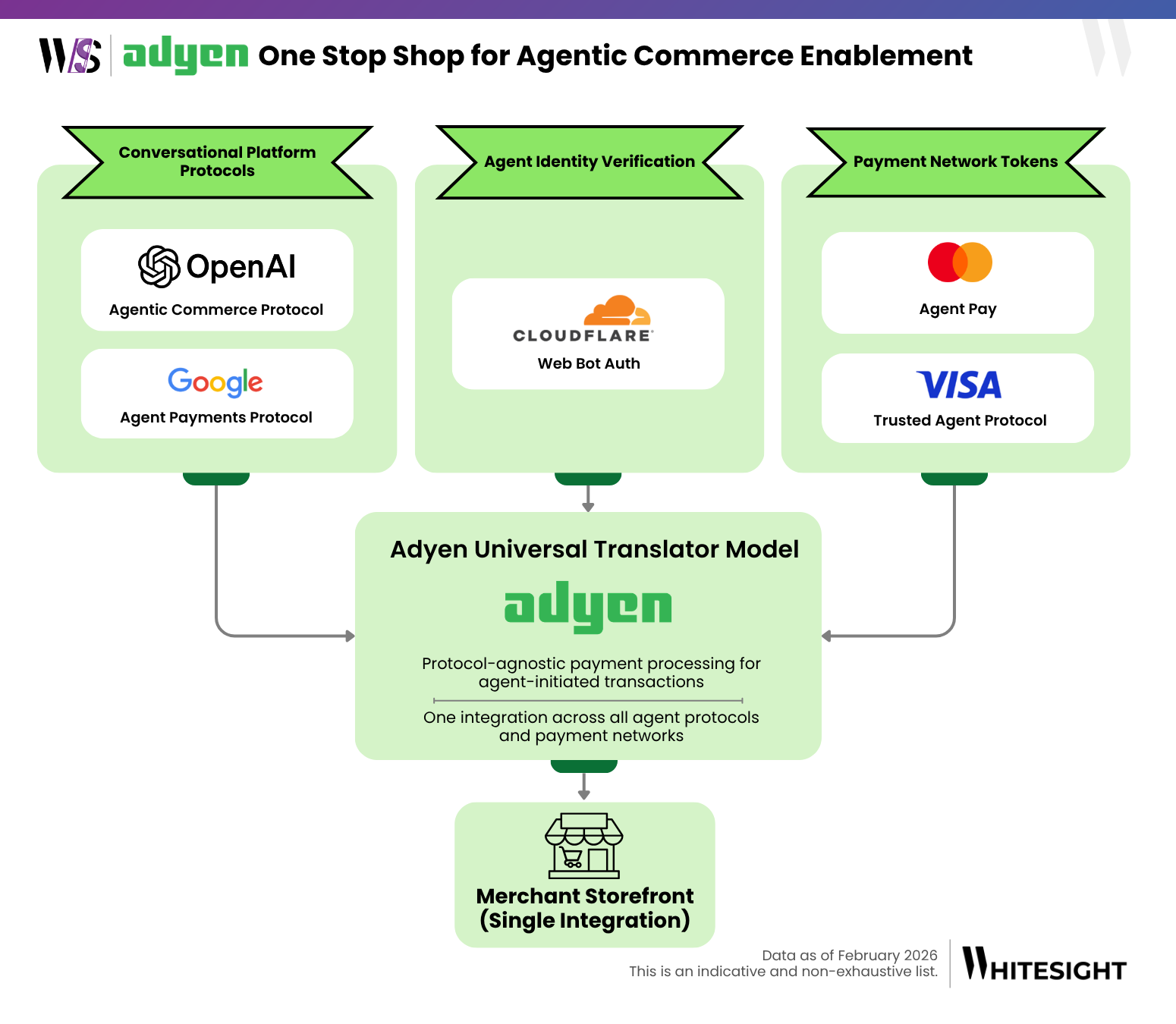
The protocol alliances: Adyen has embedded itself into the open standards that will govern the agentic commerce economy.

  • The Google AP2 partnership: Adyen is a core collaborator on Google’s Agent Payments Protocol (AP2). This open framework allows AI agents to securely transact using cryptographic mandates.
  • The Visa TAP framework: Alongside Visa and Cloudflare, Adyen supports the Trusted Agent Protocol (TAP). While AP2 handles the payment, TAP handles the identity, using HTTP Message Signatures to verify in real-time that an agent is legitimate and not a malicious bot.
  • Founding the AAIF: In December 2025, Adyen joined the Agentic AI Foundation (AAIF) as a Gold member, alongside OpenAI, Anthropic, Google, and Microsoft. The AAIF, formed under the Linux Foundation, establishes interoperability standards for autonomous AI systems. 

WhiteSight Radar: the fintech intel pros trust 🚀

Ensuring merchant sovereignty: For merchants, the greatest risk of agentic commerce is losing the customer relationship to the AI interface. Adyen’s merchant-first framework is designed to prevent this by enforcing four key pillars of control:

  1. Verifiable intent: Payments only trigger when an agent provides cryptographically signed proof of the user’s specific instruction, preventing unauthorised spending.
  2. Merchant-owned tokenisation: Using the Universal Token Vault, only merchants and not the AI platforms own the payment credentials. This ensures that if a customer wants a refund or a subscription change, they must still engage with the merchant’s own systems.
  3. The persistent identity layer: Adyen uses a single, persistent payment token across both human and agentic channels. This allows a merchant to recognise that the AI agent buying a coffee is the same “loyal customer” who usually buys in-store, preserving loylty points and personalised offers.
  4. Data ownership: Adyen ensures that transaction data and post-purchase insights remain with the merchant, preventing AI agents from capturing the customer’s lifetime value data.

As Karan Katyal, Adyen’s VP of Digital Commercial Strategy, notes: “Retailers aren’t worried about whether agentic commerce will drive demand; they’re worried about who owns the relationship when that demand shows up”.

By positioning itself as the neutral infrastructure for these protocols, Adyen offers merchants a strategic sanctuary. It allows them to embrace the massive volume of agent-led traffic while ensuring they are not reduced to anonymous fulfilment centres for big tech’s AI agents. The merchant chooses Adyen for sovereignty. The protocol ensures agent traffic arrives through Adyen regardless. This positions Adyen to capture an entirely new transaction channel.

Supercharge your Fintech IQ with WhiteSight Radar

Join Radar for exclusive member benefits and access to expert reports, industry trend breakdowns, and insights on everything from Embedded Finance to Digital Banking, Open Finance and beyond.

Internal use-case: AI for internal operating leverage

In the fintech world, growth usually demands a linear increase in headcount. Adyen is using AI to break this link. It is aiming for a revenue-per-employee ratio closer to a high-margin software company than a traditional financial institution.

In 2026, Adyen processed over ~€1.4 trillion ($1.6 trillion) in volume with a workforce of approximately 4771 employees. To put this in perspective, its primary competitor, Stripe, requires nearly double the headcount (~8,500 employees) to manage a volume of $1.9 trillion.

Adyen’s revenue per employee has peaked at €0.57 million, significantly outperforming the industry median of €0.37 million.

The smart ticket revolution:

Adyen partnered with LangChain to deploy a smart-ticket routing system.

  • Automated triage: AI agents analyze the intent, sentiment, and technical complexity of incoming support tickets in real-time.
  • Expert matching: The system instantly routes queries to the engineer or support agent with the specific expertise required for that merchant’s stack.
  • Agent copilots: Internal support agents use AI copilots to draft responses and pull relevant documentation. This reduces the average handle time and allows a single agent to manage a larger portfolio of enterprise clients.

The private stack advantage:

Adyen’s “build-over-buy” philosophy extends to its infrastructure. Adyen hosts its large language models on private, in-house infrastructure. This sovereign AI approach provides two critical advantages:

  1. Compliance at speed: Because the AI never touches the public cloud, Adyen can use sensitive transaction data to train its models without violating global privacy mandates.
  2. Operational resilience: By managing its own servers in Europe, the US, and Asia, Adyen avoids the latency issues and outages common with public AI APIs.

Applied research: This leverage is managed by Adyen’s applied research engineering hubs in Amsterdam, Madrid, and San Francisco. These researchers focus on “reinforcement learning for integrity risk” and “AI agents for data analysis”, tools designed to automate the most complex parts of the business.

Orchestrating intelligence in an agent-led economy

Adyen is executing a strategy that most payment processors cannot replicate. The fintech has built AI capability from the foundation up, positioning itself as mandatory infrastructure for the agent-led economy. The five-layer architecture shows how AI becomes an economic engine, switching cost, operating leverage, and protocol positioning simultaneously. Our full deep dive on Adyen examines how embedded finance, platform economics, and network effects compound this foundation. Download the complete Adyen strategy teardown to see how these layers connect to the company’s broader competitive positioning. 

Get Unlimited Access to Strategy Playbooks
of Fintech Pioneers! 🚀

Unlock the deep dives into the winning strategies of Nubank, Monzo, Revolut, and more with a WhiteSight Radar Membership.

Be the First to Know About the Next Big Fintech Strategies!

Don’t miss out on the next big fintech wave! Follow us on LinkedIn and subscribe to our Future of Fintech Newsletter to be the first to know about the Next Big Fintech Strategies.


    Authors

    Founder & CEO | sanjeev@whitesight.net

    Sanjeev is a fintech aficionado who loves to explore the depths of the industry as much as he loves to explore the depths of the ocean in his scuba gear. He is the founder and CEO at WhiteSight, bringing a wealth of research and advisory experience to the fintech world.

    Senior Research Associate

    Risav is a senior research associate at WhiteSight, where he spends his days navigating the complex fintech landscape and poring over market trends. When he's not decoding the world of fintech, you'll find this sports fanatic decoding the perfect curveball on the football field.

    Already a subscriber? Log in to Access

    Unlock this blog

    Gain exclusive access to this blog alone.

    Radar Subscription

    Select a membership plan that resonates with your
    goals and aspirations.

    Not Ready to Subscribe?

    Experience a taste of our expert research with a complimentary guest account.

    We publish new research regularly. Subscribe to stay updated.
    No spam. Only the best in class fintech analysis.


      Related Posts
      An infographic representation of companies involved in verification and fraud prevention using open banking in 2024.
      Complimentary Research
      An infographic representation of partnerships and product launches driving B2B growth through embedded lending, payments, cards, banking, and insurance solutions.
      Complimentary Research
      An infographic design showcasing how embedded insurance simplifies coverage in everyday consumer journeys with various companies and industries involved.
      Complimentary Research
      Infographic representation of how open banking is transforming credit decisioning in 2024. Featuring partnerships between leading fintechs and financial institutions.
      Premium Research $

      The Impact of Open Banking on Credit Decisioning Welcome to the 2024 edition of WhiteSight’s annual roundups – a deep...

      Infographic design illustrating the timeline of UPI's global expansion, highlighting key milestones, partnerships, and the growing number of countries adopting India's Unified Payments Interface.
      Complimentary Research
      Infographic design illustrating the intersection of telecom and finance companies, featuring brands like Revolut, T-Mobile, Safaricom, and others.
      Complimentary Research
      Select currency
      WS_Logo_-for-White-BG-01.png