WhiteSight

Stripe’s $1.1 Billion Bridge to Programmable Money

Table of Contents

Stripe’s stated mission since its founding has been to ‘grow the GDP of the internet.’ For GDP to grow, money needs to move across borders, between currencies, from one economy into another. Today, that movement remains expensive and slow. Annual cross-border payment flows total $179 trillion, spanning B2B supplier payments, consumer commerce, and remittances. Fees still run above 3%, and settlement takes two to three days through correspondent banking rails. For a company that processes $1.9 trillion in annual payments, every point of friction in that flow is a constraint on the mission.

Stablecoins are removing that friction. John Collison compares the adoption path to what he calls the ‘WhatsApp effect.’ WhatsApp became essential internationally first because SMS was expensive in most countries, and then it gradually went mainstream in the US. Stablecoins are following the same arc. It is starting with remittances and cross-border payouts in emerging markets where traditional rails are broken, then spinning back toward developed economies as familiarity grows. Just as WhatsApp made global communication nearly free, stablecoins promise to do the same for international commerce.

The numbers back this up. According to McKinsey, stablecoin payment volume reached $390 billion in 2025, more than doubling 2024 levels. B2B stablecoin payments accounted for $226 billion of that, up 733% year over year. On the consumer side, stablecoin-linked card spending grew to $4.5 billion, up 673% from 2024. At Stripe Sessions, John Collison put it plainly: stablecoins are showing ‘real utility for real businesses at a growth rate which eclipses anything we’ve seen before in Stripe, including Stripe itself.’ US Treasury Secretary Scott Bessent has predicted that stablecoin supply could reach $3 trillion by 2030. Citi’s bull case puts it at $4 trillion.

Stripe is building for that future. Since its $1.1 billion acquisition of Bridge in 2024, the company has assembled a vertically integrated stablecoin stack. It spans from settlement blockchain to merchant checkout and is also sold to other companies through Bridge. Two layers. One architecture.

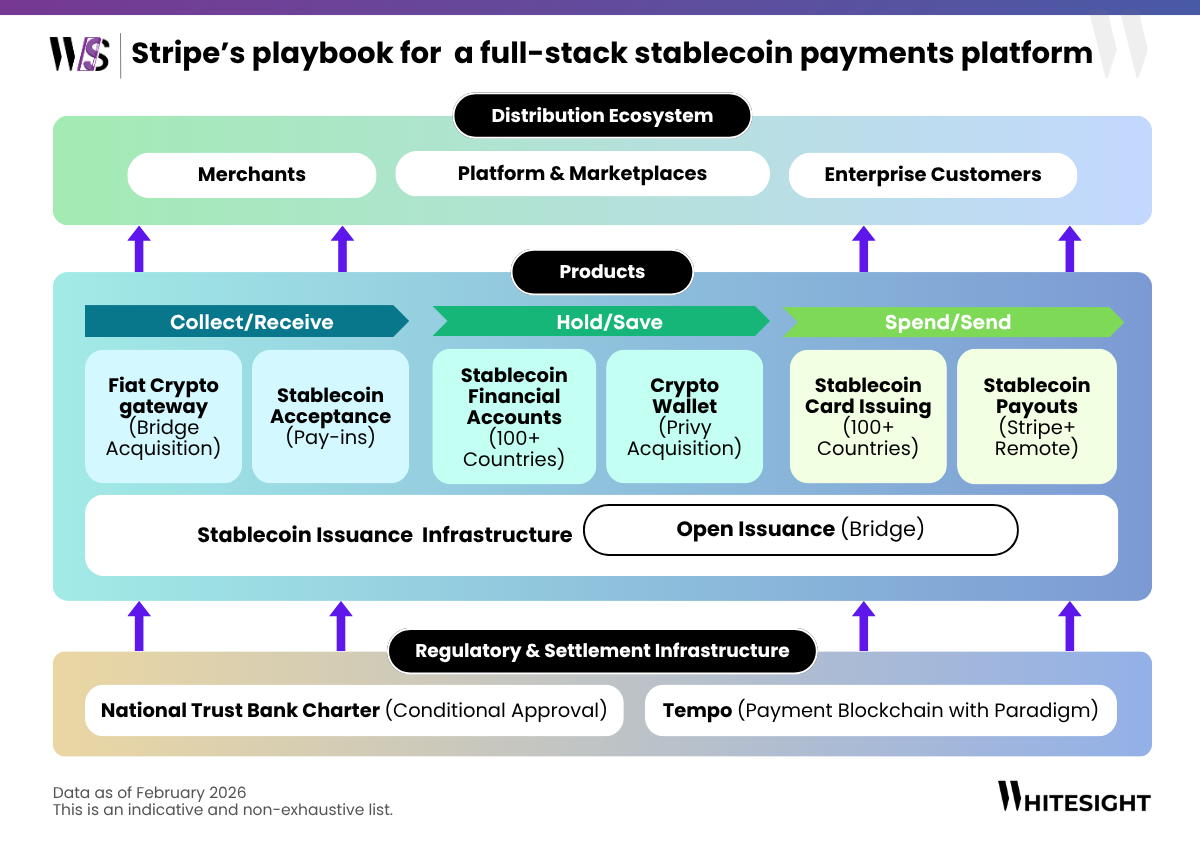
Stripe’s strategy becomes clearer when we zoom out. The company is assembling a load-bearing stablecoin stack, where each layer strengthens the next. The goal is straightforward: control the key infrastructure that allows stablecoins to move through real commerce.

Infographic showing Stripe’s full-stack stablecoin payments ecosystem, including Bridge acquisition, crypto wallets, and global issuance infrastructure.
Stripe is making strategic bets across the omnichannel commerce, digital assets, embedded finance, and AI. From enabling individual creators with powerful commerce tools to exploring the next frontier predictive technology, the company is shaping the future of digital commerce. Explore what is driving this strategy in our deep dive analysis. Check out the report now!
Report

Start at the bottom of the stack. In February 2026, Bridge received a conditional national trust bank charter from the OCC. This gives it federal oversight for stablecoin issuance, digital asset custody, and reserve management. Months earlier, Stripe and Paradigm had launched Tempo, a payments-first blockchain targeting 100,000+ transactions per second with sub-second finality. Tempo raised a $500 million Series A at a $5 billion valuation, with partners including Visa, Deutsche Bank, Nubank, and Revolut. Together, the OCC charter and Tempo provide Stripe with a federally regulated issuance licence sitting on top of purpose-built settlement rails.

One layer up sits issuance. Bridge mints USDB, its own stablecoin backed 1:1 by BlackRock money market funds. But the more consequential product is Open Issuance, launched in September 2025. It lets any company create and manage its own stablecoin with a few lines of code. Reserves are managed by BlackRock, Fidelity, and Superstate. The economic hook is simple: popular stablecoins like USDC and Tether retain all reserve earnings. Open Issuance lets the issuing business capture that yield, currently 3-4% on US Treasuries. For a neobank or fintech sitting on large stablecoin deposits, this changes the unit economics entirely.

Above the issuance sits the products layer. This set of tools moves stablecoins through the three stages of a transaction: collecting them, holding them, and spending them.

On the collect side, Bridge’s fiat-crypto gateway lets businesses accept payments in both traditional currencies and stablecoins through a single integration. Stablecoin acceptance, turned on by default in Stripe’s checkout since September 2025, lets merchants receive stablecoin pay-ins alongside card payments without any additional setup. 

Once collected, Stablecoin Financial Accounts, launched in 101 countries, let businesses hold, send, and receive in USDC and USDB. Privy, acquired in June 2025, provides the embedded wallet infrastructure underneath. It powers 110 million+ accounts where users and businesses store their stablecoin balances without managing seed phrases or blockchain complexity.

Then comes spending. Bridge-Visa stablecoin cards convert stablecoin balances to local fiat at the point of sale across 175 million merchant locations. On the payout side, businesses can Stripe to send stablecoins directly to contractors, creators, and suppliers in 69 countries, settling in minutes rather than days.

At the top of the stack sits distribution, the ecosystem of merchants, platforms, and enterprise customers building on this infrastructure. Klarna issued KlarnaUSD for its 114 million customers. Phantom launched CASH for its 20 million+ monthly active users. MetaMask launched mUSD for 100 million+ annual users, spendable at any Mastercard merchant. Payoneer is embedding Bridge-powered stablecoin workflows for nearly 2 million cross-border SMBs. In Latin-America, Felix Pago is using Bridge to power remittances and Starlink is repatriating funds from Argentine sales. Consumers in Nigeria are paying for YouTube Premium and ChatGPT with stablecoins. Airtm provides dollar access in volatile-currency economies, and Chipper Cash handles cross-border payments across Africa.

Then there is Meta. The company that spent years and billions building Libra, only to have regulators kill it, is now experimenting with stablecoin payments. But this time, Meta is not building the infrastructure itself. Zuckerberg has publicly acknowledged that Stripe’s approach ‘makes much more sense than what we were doing.’ Patrick Collison joined Meta’s board shortly after. Bridge is now a reported candidate to provide stablecoin infrastructure for Meta’s apps.

By owning every layer, from the ledger to the license, Stripe has made itself significantly harder to compete against. Pure-play crypto infrastructure providers like Circle or Paxos have built some of these layers, but not all of them. This integration is what separates Stripe from pure-play crypto infrastructure providers.

WhiteSight Radar: the fintech intel pros trust 🚀

The Double-Layered Gambit of Internal Utility vs. External SaaS

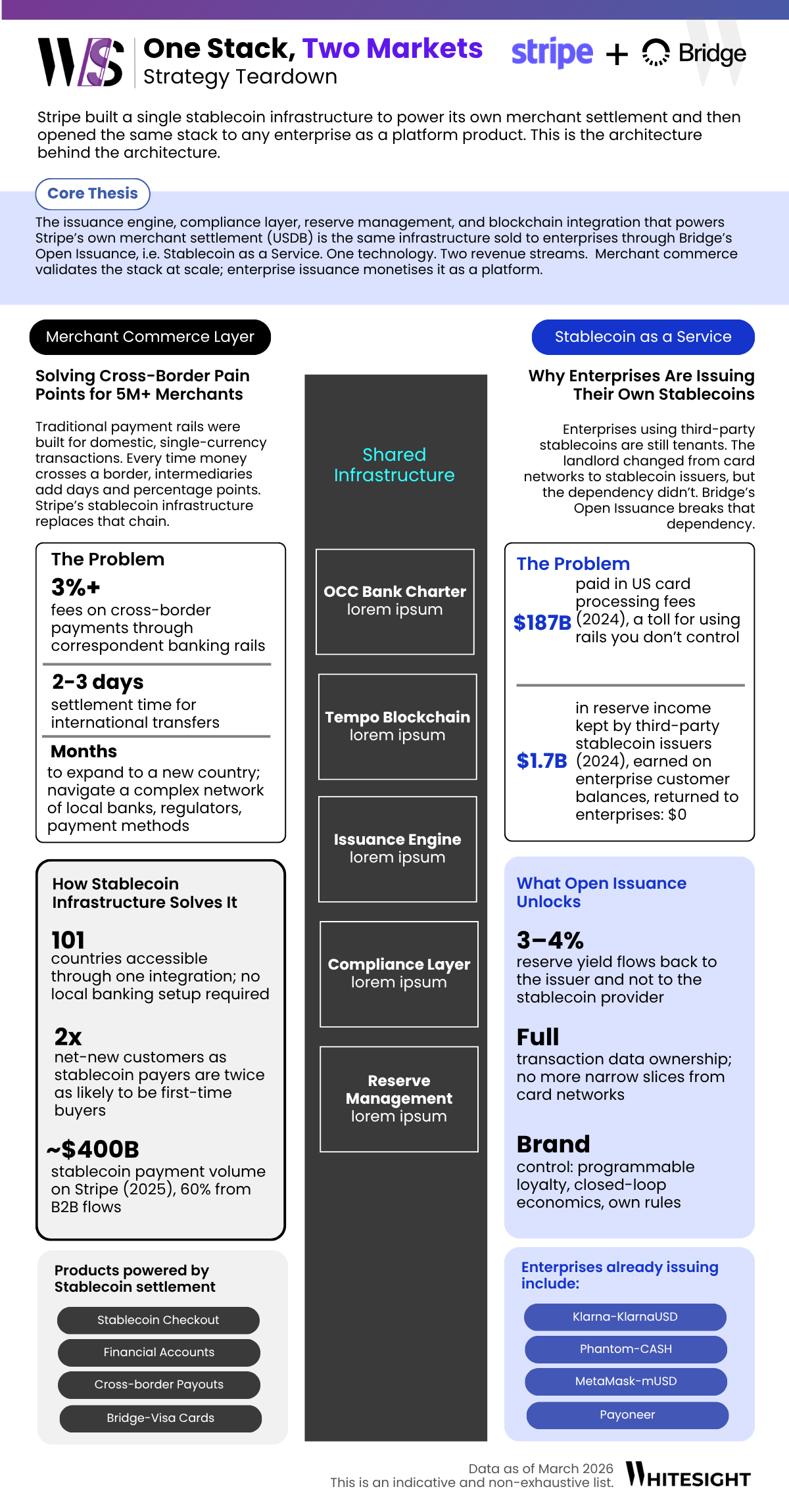
At the centre of Stripe’s stablecoin stack sits USDB, Bridge’s own stablecoin, backed 1:1 by BlackRock money market funds. Alongside USDC, Stripe uses USDB as the default settlement asset across its own merchant products: financial accounts, card programmes, and cross-border payouts. The infrastructure behind USDB, the issuance engine, the compliance layer, the reserve management, and the blockchain integration is the same infrastructure that powers Open Issuance for external clients. One technology serving two markets. Amazon built AWS to run its own e-commerce infrastructure, then opened it to the world. Google did the same with Cloud. Stripe built its stablecoin infrastructure to serve its 5M+ merchants, and is now selling that same infrastructure to any company that wants its own stablecoin. a16z expects USDB to become the default stablecoin across Stripe products, giving Stripe a proprietary settlement asset that passes yield to developers.

Solving merchant pain points with stablecoins

The products described in the stack above, financial accounts, checkout, cards, and payouts, are Stripe’s answer to a set of merchant pain points that have persisted for decades.

The core problem is structural. Traditional payment rails were built for domestic transactions in a single currency. Every time money crosses a border, it enters a system of intermediaries that was never designed for speed or efficiency. The merchant’s customer pays in their local currency. The merchant receives in their’s. But in between, stablecoins replace the correspondent banking chain that historically added days and percentage points to every transfer.

This matters because Stripe’s merchants are going global faster than any previous generation of internet businesses. Neetika Bansal, Stripe’s Head of Money as a Service, framed the shift clearly: ‘With stablecoins, we can take our financial services, make them global, and make them programmable from day one.’ Previously, expanding to a new country meant establishing local banking relationships, navigating regulatory requirements, and integrating with local payment methods. This is a process that could take months per market. Stablecoin financial accounts collapsed that timeline to near-zero. One integration. 101 countries.

What makes Stripe’s approach distinct is that the merchant doesn’t need to understand any of this. A merchant turns on stablecoin checkout alongside card payments. The business receives funds into a financial account without knowing whether they arrived via ACH or a blockchain. The underlying stablecoin infrastructure is abstracted away. Patrick Collison reinforced this during his Congressional testimony: ‘These businesses are not using crypto because it’s crypto or for speculative benefit. They’re performing real-world financial activity.’

The early data validates the approach. Customers paying with stablecoins on Stripe are twice as likely to be net new compared to other payment methods. This is the detail that matters most strategically. Stablecoins are reaching customers who wouldn’t have converted through traditional checkout, in markets where traditional rails were never a good fit.

Why enterprises are building their own stablecoins

The second layer is where Stripe’s strategy compounds. Through Bridge, any company can issue and manage its own branded stablecoin without building compliance, reserve management, or blockchain infrastructure from scratch.

For decades, every business that accepted digital payments was a tenant on someone else’s infrastructure. Visa and Mastercard owned the rails. Banks owned the settlement. The merchant paid rent on every transaction and had no say over the speed, the cost, or the data that flowed through the system. US businesses paid $187 billion in card processing fees in 2024 alone. That is a toll for using infrastructure you don’t control.

Stablecoins promised to change this. Transactions that once took days could settle in seconds. Cross-border fee transfers dropped to fractions of a cent. Money could move 24/7 without waiting for banks to open in different time zones. But for enterprises adopting stablecoins like USDC or USDT, one fundamental problem remained: they were still tenants. The landlord changed, from Visa to Circle, from Mastercard to Tether, but the dependency didn’t. The enterprise couldn’t customise the asset. It couldn’t embed its brand into the payment experience. It couldn’t programme loyalty or rewards into the token itself. And critically, it didn’t earn the yield. Circle collected roughly $1.7 billion in reserve income in 2024. The businesses whose customer balances generated that income saw none of it.

Bridge’s Open Issuance breaks this dependency. It enables an enterprise to issue its own branded stablecoin, with its own name, its own rules, its own economic model. The economics shift in three ways once you own the coin rather than rent someone else’s.

The first is yield. Every stablecoin in circulation is backed by reserves, typically US Treasuries and cash. Those reserves earn 3-4% annually. When a business holds customer balances in USDC, Circle captures that interest. When the same business issues its own stablecoin through Bridge’s Open Issuance, the reserve revenues flow back to the issuer net of issuance fees. Will Gaybrick, Stripe’s President of Technology and Business, cited Amazon and American Express as the kinds of companies that could benefit from this model. For a platform sitting on billions in customer balances, the reserve income alone justifies the decision.

The second is data. Card networks give merchants a narrow view of their own customers. The bank sees the full picture. The processor sees a different slice. The merchant gets what’s left. With a proprietary stablecoin, that dynamic inverts. The enterprise sees the complete transaction flow, what customers buy, when, how often, and through which channels. This powers personalisation, fraud detection, and loyalty design without handing data to external intermediaries.

The third is control. Bridge compares the model to Starbucks gift cards. Customers preload funds and earn rewards for using them, keeping them inside the ecosystem. A branded stablecoin takes that closed-loop model digital and global. Rewards become programmable and instant. A rideshare company can reward every trip with tokens that also work at partner restaurants or delivery apps. A marketplace can settle with sellers in its own stablecoin, reducing FX friction and settlement delays while keeping liquidity within its network. The enterprise chooses whether the stablecoin stays closed-loop for tighter control or opens to partner ecosystems for broader reach.

Bridge CEO Zach Abrams put it bluntly at the Open Issuance launch: ‘Don’t build on top of someone else’s coin.’ Bridge handles the compliance, reserve management, smart contracts, and blockchain deployment. The enterprise brings the brand, the customers, and the strategy. The result is a stablecoin that settles in seconds, costs pennies to transact, earns yield on reserves, and generates richer data.

Supercharge your Fintech IQ with WhiteSight Radar

Join Radar for exclusive member benefits and access to expert reports, industry trend breakdowns, and insights on everything from Embedded Finance to Digital Banking, Open Finance and beyond.

The Next Frontier for Stablecoins in Agentic Commerce

Stripe’s stablecoin push is also closely tied to another structural shift: the rise of agentic AI and machine-to-machine commerce. 

Card networks were built for humans clicking checkout buttons, fixed fees, percentage-based pricing, and manual approval flows. But for AI agents, traditional credit cards are an evolutionary dead end. They are too slow, too prone to fraud, and structurally incapable of handling the sub-cent ‘nanopayments’ that power machine-to-machine economies.

Stablecoins fit perfectly because they are programmable, instant, and have a near-zero cost. Stripe has already integrated the x402 protocol on Base, allowing AI agents to send and receive USDC payments autonomously through Stripe’s infrastructure. Tempo is designed to handle over 100,000 transactions per second and confirm them in under a second. These numbers seem excessive for consumer checkout, but start to make sense when the buyers are machines. John Collison recently predicted a ‘torrent’ of AI agentic commerce running on stablecoins and high-throughput blockchains. At the Bloomberg interview during Stripe Sessions, he framed it simply: ‘your Claude Code instance is building something for you, and it needs ‘a credit card or some way to go spend money in the broader world.’ Stablecoins are that way.

Stripe is already the payments provider for OpenAI, Anthropic, and Perplexity. It is now building the stablecoin rails that those same companies’ agents will transact on. Will Gaybrick, Stripe’s President of Technology and Business, calls stablecoins and agentic AI ‘twin revolutions in intelligence and money.’ The company sitting at the intersection of both is the same one that just assembled a full stablecoin stack.

Building the Plumbing for Programmable Money

Stripe’s 2025 annual letter identified ‘two gale-force tailwinds’ reshaping the economic landscape: AI and stablecoins. Most companies are betting on one or the other. Stripe built infrastructure for both and connected them through the same stack.

Stripe started with seven lines of code to accept a credit card payment. Today, it operates a federally chartered stablecoin issuer and a purpose-built blockchain. It also runs a stablecoin-as-a-service platform and payment rails for the world’s leading AI companies. Stripe needed a Bridge between old money and new. It bought one.

Get Unlimited Access to Strategy Playbooks
of Fintech Pioneers! 🚀

Unlock the deep dives into the winning strategies of Nubank, Monzo, Revolut, and more with a WhiteSight Radar Membership.

Be the First to Know About the Next Big Fintech Strategies!

Don’t miss out on the next big fintech wave! Follow us on LinkedIn and subscribe to our Future of Fintech Newsletter to be the first to know about the Next Big Fintech Strategies.


    Authors

    Founder & CEO | sanjeev@whitesight.net

    Sanjeev is a fintech aficionado who loves to explore the depths of the industry as much as he loves to explore the depths of the ocean in his scuba gear. He is the founder and CEO at WhiteSight, bringing a wealth of research and advisory experience to the fintech world.

    Senior Research Associate

    Risav is a senior research associate at WhiteSight, where he spends his days navigating the complex fintech landscape and poring over market trends. When he's not decoding the world of fintech, you'll find this sports fanatic decoding the perfect curveball on the football field.

    Already a subscriber? Log in to Access

    Unlock this blog

    Gain exclusive access to this blog alone.

    Radar Subscription

    Select a membership plan that resonates with your
    goals and aspirations.

    Not Ready to Subscribe?

    Experience a taste of our expert research with a complimentary guest account.

    We publish new research regularly. Subscribe to stay updated.
    No spam. Only the best in class fintech analysis.


      Related Posts
      An infographic representation of companies involved in verification and fraud prevention using open banking in 2024.
      Complimentary Research
      An infographic representation of partnerships and product launches driving B2B growth through embedded lending, payments, cards, banking, and insurance solutions.
      Complimentary Research
      An infographic design showcasing how embedded insurance simplifies coverage in everyday consumer journeys with various companies and industries involved.
      Complimentary Research
      Infographic representation of how open banking is transforming credit decisioning in 2024. Featuring partnerships between leading fintechs and financial institutions.
      Premium Research $

      The Impact of Open Banking on Credit Decisioning Welcome to the 2024 edition of WhiteSight’s annual roundups – a deep...

      Infographic design illustrating the timeline of UPI's global expansion, highlighting key milestones, partnerships, and the growing number of countries adopting India's Unified Payments Interface.
      Complimentary Research
      Infographic design illustrating the intersection of telecom and finance companies, featuring brands like Revolut, T-Mobile, Safaricom, and others.
      Complimentary Research
      Select currency
      WS_Logo_-for-White-BG-01.png